Many Virginia higher education workers were excluded from the legislation to expand collective bargaining rights to public-sector workers.
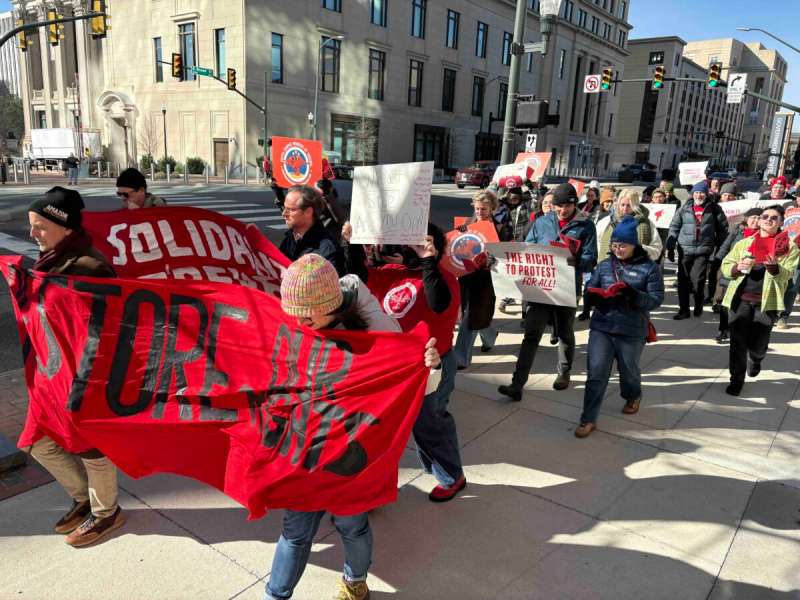
With the clock ticking on Gov. Abigail Spanberger to act on the bills sent to her by the Virginia General Assembly, campus workers hope a petition can help push her to add them back into the public-sector collective bargaining legislation awaiting her signature.
The United Campus Workers of Virginia started an online petition for Spanberger to add higher education faculty, student workers, and all staff back into the legislation that would expand collective bargaining rights to hundreds of thousands of public-sector workers in Virginia.
They were originally included, but the legislation was changed to include only “service employees” in higher education like janitors, security officers, or groundskeepers. That means that university faculty, graduate student teaching assistants, librarians, admissions staff, and athletics workers would be excluded.
Leaders of the unions representing these workers understand Spanberger may not add them back in and are already looking to next year’s legislative session.
“If she doesn’t add us back in—and I don’t think that the odds are great that she’s going to be willing to do that at this point—then what we need to do is get our team together and develop a much stronger legislative strategy for 2027,” said Harry Szabo, president of University Campus Workers of Virginia.
Szabo said there seems to be a perception that certain higher education workers don’t need collective bargaining, but Szabo noted that wages for graduate student workers have not kept up with the cost of living.
“The cost of housing has gone up in basically every university town,” Szabo said. “And in at least some departments, graduate workers are being paid the same thing that they were being paid 10 years ago.”
Wages for graduate students vary, but some make as little as $14,000 a year, Szabo said.
It’s not clear exactly why certain higher education workers got excluded from the legislation, but one argument made against their inclusion is that collective bargaining would increase the labor costs for public universities and force schools to raise tuition.
But Szabo noted that tuition hikes are happening anyway.
Virginia Commonwealth University’s Board of Visitors said in March it is considering a tuition increase of between 2.5% and 4.9%, The Commonwealth Times reported. And Axios Richmond reported that the average cost of in-state tuition and fees at Virginia’s public colleges and universities rose by more than 2% in 2025—the fourth year in a row there was an increase.
Tim Gibson, the president of the Virginia Conference of the American Association of University Professors, said state funding for higher education has fallen in recent years, so if that were restored, there would be little need to raise tuition at all. He also added that Virginia could rebalance its tax system so wealthy individuals and corporations pay their fair share to help raise revenue.
Still, collective bargaining for faculty is about much more than just better wages, Gibson said.
“If you want to defend the university from attacks, you need faculty to have collective power and to feel united and secure enough that they can stand up…to the federal government, to the external actors who want to interfere with universities, how they operate, and what they teach,” Gibson said. “So really, collective bargaining is about much more than just salaries.”
Spanberger has until April 13 to act on the bill. If she makes changes, then the Virginia General Assembly would have to take them up for consideration during its “veto session” on April 22.