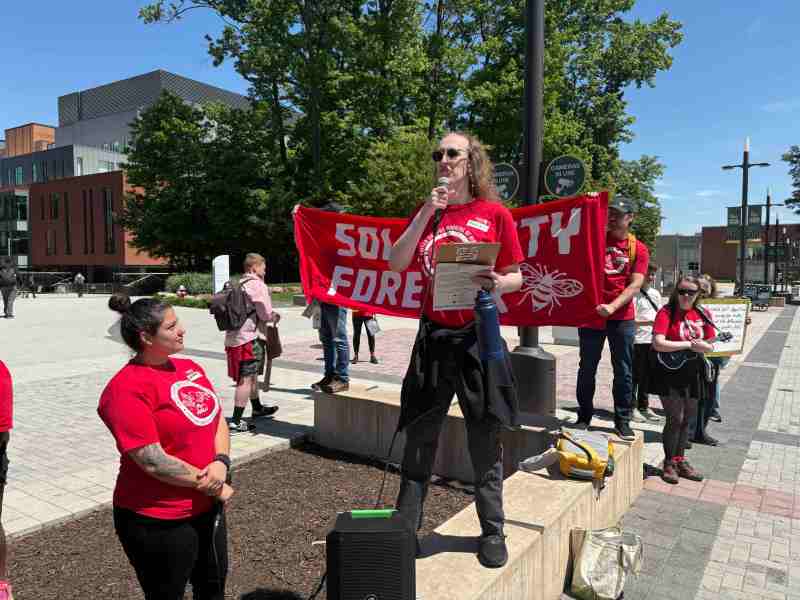
At a May Day rally in Fairfax, a group of campus workers went public with their union and a state lawmaker called on Gov. Abigail Spanberger to sign public-sector collective bargaining legislation.
As it continues advocating for better state labor policy, the United Campus Workers of Virginia (UCWVA) is expanding its presence with a new chapter in Northern Virginia.
UCWVA announced on Friday it had organized a chapter at George Mason University. The timing of the announcement coincided with International Workers’ Day on May 1.
The kick off rally on Friday for the George Mason chapter of UCWVA comes after campus workers there spent two years organizing themselves. They want pay that keeps up with the cost of living, better job security, and transparency around layoffs, speakers at the rally said.
“ Pay is stagnant,” said Yassmin Salem, a public art manager at George Mason who helped organize workers there. “Raises are minimal or state mandated, and workloads are increasing. People are feeling it in their wallets. Every time they pay rent, every time they buy groceries.”
Drew Leisner, a physics graduate student at George Mason, said physics graduate students like him who teach and do research make only $37,000 a year—or $25,000 if they only work during the fall and spring semesters.
Leisner recalled how a delay to the finalization of his contract led to him and his wife missing out on healthcare for a month for two years in a row. That meant his wife couldn’t get treated for her severe migraines and had to miss work. Leisner learned that graduate students in other departments were dealing with similar issues and joined the organizing effort for fair contracts.
“As we’ve talked to people all over campus, we’ve learned that the same problems we faced in the College of Science affect workers in all departments,” Leisner said at Friday’s rally. “From history to engineering, from psychology to the writing center, people are getting screwed over.”
Another big concern for campus workers at George Mason is the role AI plays at the university.
Last June, George Mason announced the roll out of an AI platform called PatriotAI as part of a partnership with Microsoft and Cloudforce. George Mason launched an AI masters program last year, and it has a chief artificial intelligence officer that leads the school’s “implementation of AI across research, academics, and partnerships for the university.”
But campus workers have concerns about training AI programs that could end up replacing them and how increased AI use at George Mason could be used to justify layoffs. During the rally at George Mason’s campus, food delivery robots pushed through the crowd and in one instance caused someone to fall.
“We don’t want a university run by bots,” Salem said. “We want a university run by people.”
George Mason did not respond to a request for comment.
Friday’s May Day rally also included calls for Gov. Abigail Spanberger to sign legislation to expand collective bargaining rights to public workers, including some campus workers.
Currently, state workers are banned from collective bargaining, and local government workers can only do so if their localities permit it.
Labor unions are urging Spanberger to sign the legislation that passed out of the Legislature, which rejected Spanberger’s proposed changes to it. Spanberger told WRIC reporter Tyler Englander last week she was still making up her mind.
At Friday’s rally, state Del. Elizabeth Guzman (D-Nokesville) called on Spanberger to sign the legislation after voters propelled the governor to a 15-point victory last year. These voters wanted leaders who were “pro-worker and pro-working families,” Guzman said.
“ There is no time for us to go backwards because we have bigger fights fighting Donald Trump at this moment,” Guzman said. “And the least that we could do is ensure that we have a collective bargaining law that will be inclusive of all workers, including higher education workers.”