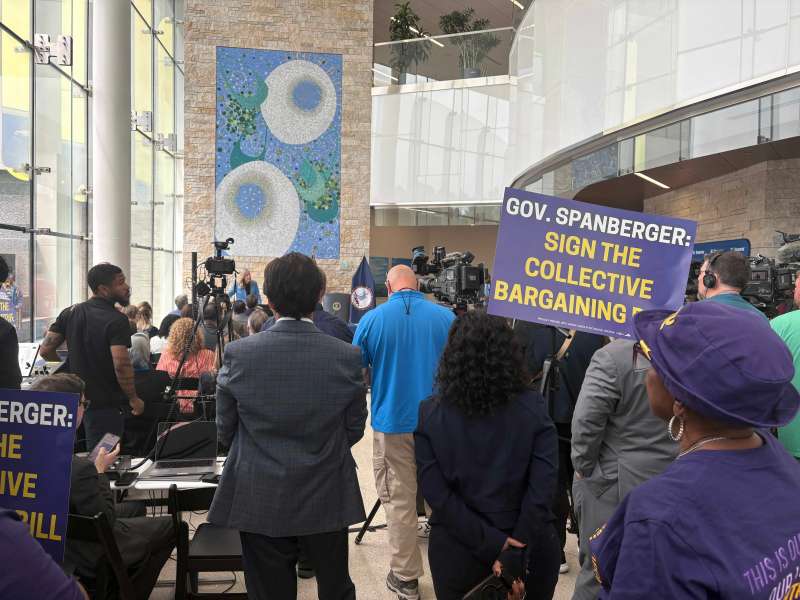
Labor leaders around the state are reacting with a mixture of disbelief, anger, and disappointment after learning that Gov. Abigail Spanberger plans to block one of their top priorities.
Virginia labor leaders are shocked and furious over Gov. Abigail Spanberger’s plans to block the expansion of collective bargaining rights to public sector workers.
Dogwood first reported Wednesday that Spanberger, a Democrat less than a year into her term, had called Virginia Senate Majority Leader Scott Surovell, a sponsor of the legislation, to let him know she planned to veto the collective bargaining legislation sent to her by Democrats in the General Assembly. Spanberger has also called labor leaders to let them know she plans to veto a top priority they have been working on for years.
“We had high hopes for her,” said LaNoral Thomas, president of Service Employees International Union (SEIU) Virginia 512. “We believed that she was being authentic and honest with us. She just flat out flipped. It is shocking.”
Thomas said Spanberger, as a candidate who SEIU Virginia 512 endorsed, had pledged to sign collective bargaining legislation if it reached her desk. And in February of this year, during SEIU’s lobbying day, Spanberger told union members and leaders she was committed to getting collective bargaining across the finish line.
“For her to take this stance and veto this bill in this political climate, she’s no better than Glenn Youngkin and the other Republicans right now,” Thomas said. “Why are you even claiming to be a Democrat when you would treat working people this way?”
Youngkin, Spanberger’s Republican predecessor, vetoed collective bargaining while in office.
Legislative back-and-forth
The legislation, which the General Assembly passed in March, would have lifted the ban on collective bargaining for public workers, and given the right to home care workers.
Spanberger sent back changes to the legislation that its supporters felt dramatically weakened the bill. Spanberger’s changes delayed implementation for local government workers and gave a state board with members appointed by the governor more say over how collective bargaining could be carried out.
The General Assembly rejected those changes, leaving Spanberger with the option to sign the legislation into law, let it become law without her signature, or veto it.
Asked by Dogwood about her plans to veto the bill, Spanberger told reporters in Fairfax on Wednesday that she had a mandate to ensure that implementation of collective bargaining was done right.
Thomas said Spanberger has had time to weigh in on the legislation.
“This was not done in a vacuum,” Thomas said. “She was fully aware at every stage. To act like she didn’t know what was going in the bill and she didn’t see the bill, it’s just wrong.”
Collective bargaining history
Virginia bans state workers and higher education workers from collective bargaining. There was also a ban on local government and school board employees from collective bargaining, but in 2020, state lawmakers changed the law so localities could pass measures on whether to allow or block their employees from collective bargaining.
It was the struggle of Black University of Virginia hospital workers against workplace segregation and for better pay in the 1940s that resulted in a 1948 state proclamation that made the ban on public sector bargaining “official state policy.”
Then, a 1977 Virginia Supreme Court ruling made public sector bargaining illegal. In 1993, lawmakers passed a state law banning public sector bargaining.
“How dare you with the history of collective bargaining in Virginia,” Thomas said. “As a white woman, you are using your privilege to continue to hold back women, women of color, immigrants, and it is just disgusting and wrong.”
‘A durable bill’
Spanberger said on Wednesday she wants to sign “a durable bill,” but it’s not clear to Doris Crouse-Mays, the president of the Virginia AFL-CIO, what that means or how the bill Spanberger plans to veto isn’t durable.
And given how much time went into the legislation and how much history there is behind it, it’s not clear to Crouse-Mays why public workers need to wait longer to win collective bargaining rights.
“There was a ban on this for like 50 years,” Crouse-Mays said of public-sector collective bargaining. “Then we made it permissible over six years ago. So then we spent an additional six years working and working, and working with localities to pass ordinances and do collective bargaining for them. So, I wish someone would tell me what the time frame is.”
Crouse-Mays wasn’t sure what future negotiations over the next version of the legislation will look like, but she knows the fight isn’t over.
“We will not stop, and we will continue to work on collective bargaining for all public employees in this state, and we’re not going to leave anybody behind,” Crouse-Mays said. “That is a durable bill.”