Reporting by Bill Atkinson, Petersburg Progress-Index
Weeks after she vetoed legislation that would create Virginia’s first retail cannabis market for adults, Gov. Abigail Spanberger and the sponsors of that legislation have worked out an agreement through a language compromise in the upcoming state budget.
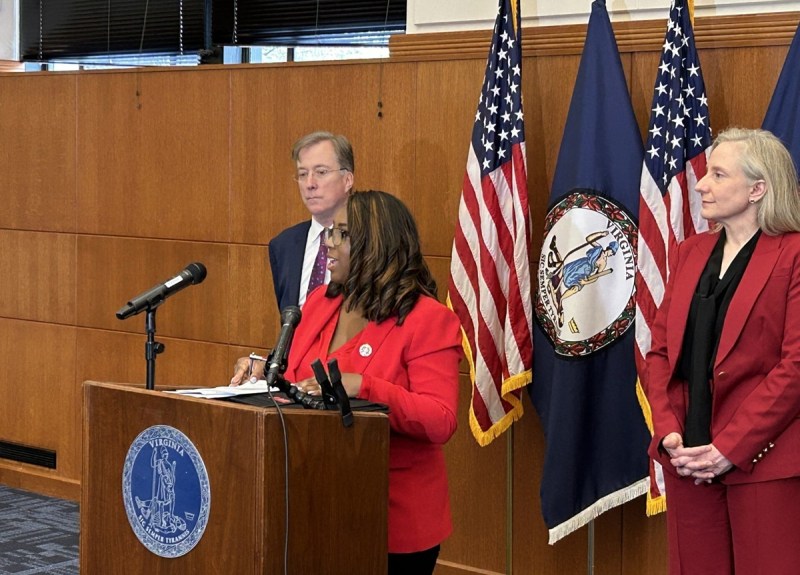
“I am excited to stand alongside Sen. Lashrecse Aird and Del. Paul Krizek to announce that we have agreed to a proposal that will create a safe, legal and well-regulated cannabis market here in the commonwealth of Virginia,” Spanberger said at a June 16 press conference in the Patrick Henry Building. “We will do it in a way that protects consumers, tamps down with the goal of eliminating the illicit market with clear enforcement and regulatory authority, and creates a more competitive market for small businesses and farmers.
Aird, D-Henrico County, and Krizek, D-Alexandria, joined Spanberger for the news conference, with both expressing gratitude that they were able to craft budget language that satisfies – for now – a years-long desire by Virginia Democrats to follow up on the 2021 decriminalization of simple marijuana possession.
“To compromise and find agreement, leaders must be open,” Aird said. “They have to be willing to know the priorities but understand that to reach agreement, you have to be flexible in the approach that is taken, and this agreement and this compromise absolutely reflects that.”
It is also a balm on what could have been a political nightmare for Democrats. The retail cannabis market was one of 31 bills Spanberger vetoed after the 2026 legislative session, and Aird was among the loudest opponents of that veto, calling it “a slap in the face” of citizens and lawmakers who had worked long and hard to set the framework for the market.
The tone at the news conference was far more conciliatory, however, as both Aird and Krizek said they had met with Spanberger to talk through all the concerns and work out the differences. Aird said while the compromise gives “a strong foundation in framework” for the retail market, it is not the be-all, end-all.
“It’s not the end of the conversation,” Aird said. “But one thing we’re confident in is that this is a very strong foundation, a very strong framework that takes into account data from across the country, best practices, public safety input and stakeholder input. It will leave us in a much stronger place.”
What does the cannabis compromise do?
In a nutshell, the deal reached includes the following:
- It sets a launch date for the market of July 1, 2027, six months later than the original legislation set up.
- There will be a cap of 350 retail business licenses to sell retail cannabis, and those stores will be phased in over a two-year period. Aird said it gives the state regulatory power to decide how the licenses will be issued geographically.
- A Virginia cannabis tax will start at 6% upon the market launch and go to 8% after July 1, 2029.
- As with the original legislation, localities will have the opportunity to add a 1% to 3% sales tax on the products sold.
- A $250 civil fine will apply to public consumption violations, but it will be delayed while the state looks at avoiding disproportionate enforcement.
- Lawmakers will set specific funding allocations of the revenue in the 2027 General Assembly session, but 75% of the licensure revenue in the first year will go to the Cannabis Equity Business Loan Fund to assist business owners in certain areas.
- Product safety will be strongly enforced with strict testing, labeling and regulation of so-called “intoxicating hemp products” not sold in licensed cannabis stores such as vape shops.
- Virginia will establish a Cannabis Impact Business Support Team to aid business startups.
The compromise is part of the House of Delegates’ budget recommendations, even though one of the chief patrons is in the Senate. Aird told The Progress-Index there will be a placeholder for it in the Senate budget suggestions.
Process hinges on budget passage
Passage of the compromise hinges on approval of the fiscal year 2027 budget that would go into effect July 1. But squabbles between the legislative chambers over how that budget should look has made many in Richmond sweat over the possibility of a budget not being passed by June 30.
With less than two weeks to go before the fiscal year 2026 budget ends, the Senate and House have been at a stalemate over how to fund the budget. The Senate, led by Finance & Appropriations Committee Chair Louise Lucas, D-Portsmouth, wanted a billion-dollar state tax exemption for data centers eliminated while the House version kept it.
That led to tense standoffs, with Lucas criticizing Spanberger for siding with the House package and House leadership for allegedly being beholden to large cyber-industry.
There does appear to be light at the tunnel’s end, though, as Lucas and the SFAC are now advancing a proposal that would keep the exemption in place but sets up a tiered structure for data centers to pay impact fees based upon the amount of power they would need to operate.
Lucas told reporters after the June 16 committee hearing that she and her fellow Senate conferees were going to meet with the House counterparts to discuss the proposal. The House of Delegates will meet June 18 to discuss the budget proposals, followed by the Senate four days later.
Lucas made one point clear. While she was on board with the proposal, she still was not backing down from her commitment to abolishing the data center tax exemption.
Tension was prevalent in the meeting room as senators from both sides of the aisle peppered state Finance Secretary Mark Sickles with questions over the extent of the administration siding with the House over the Senate.
Sen. Richard Stuart, R-King George County, fretted from the dais about how he was concerned that the budget proposals could stall and Virginia would enter the next fiscal year with a skinny budget outline that would pay for the bare necessities – with employee pay raises not among them.
Committee member Sen. Barbara Favola, D-Arlington, quickly tried to shush that talk, saying she had confidence in conferees from both chambers that a deal will be worked out.
“There will be a budget,” Favola said firmly.
Bill Atkinson (he/him/his) has won numerous awards during his 40-year journalism career. A Petersburg native, Bill is a 1984 graduate of Virginia Commonwealth University in Richmond with a degree in mass communications. He specializes in coverage of breaking news, crime, government, and local/state/national politics. He is an avid history buff and a lifelong Washington Commanders fan. Reach him at batkinson@progress-index.com with news tips and story suggestions.
This article originally appeared on The Progress-Index.