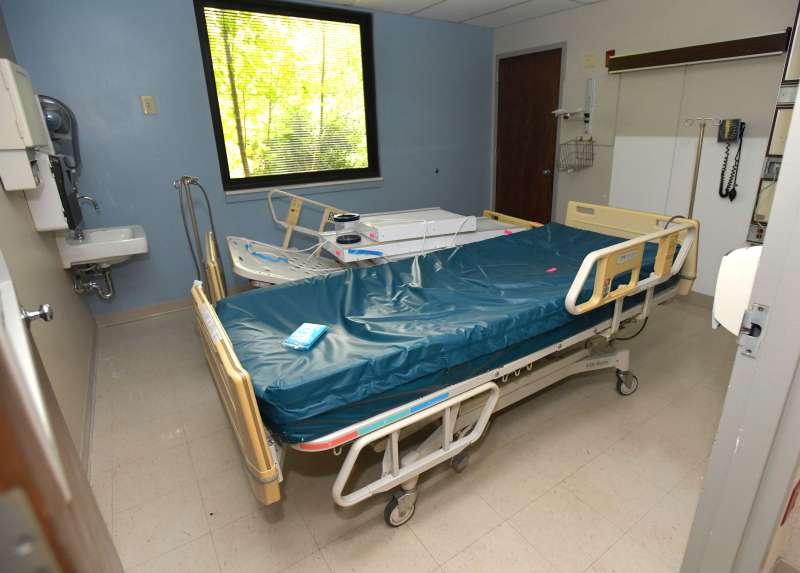
A state report released last week found that 13 rural hospitals in Virginia are at risk of closing.
About three or four times a month, Regina Gallimore-Szerokman takes the day off from her sales and marketing job to make a day trip from her home in Pulaski County to Roanoke or Charlottesville.
She does so to meet with different specialists who help monitor and care for her 14-year-old twins who have seizure disorders and are hearing impaired. While their local pediatrician in Pulaski is amazing, Gallimore-Szerokman has to make hour-long drives and take time off work to get the specialized care her twins require.
Gallimore-Szerokman said it would be better if her family and others in the community had closer healthcare options.
“We have the means and the ability to travel, but for some families, they don’t have the capability of going somewhere in North Carolina or to UVA to see a specialist,” Gallimore-Szerokman said in an interview. “And that can be detrimental to a child’s outcome.”
A report published last week by the state’s Joint Commission on Health Care has raised new concerns about healthcare access in rural Virginia.
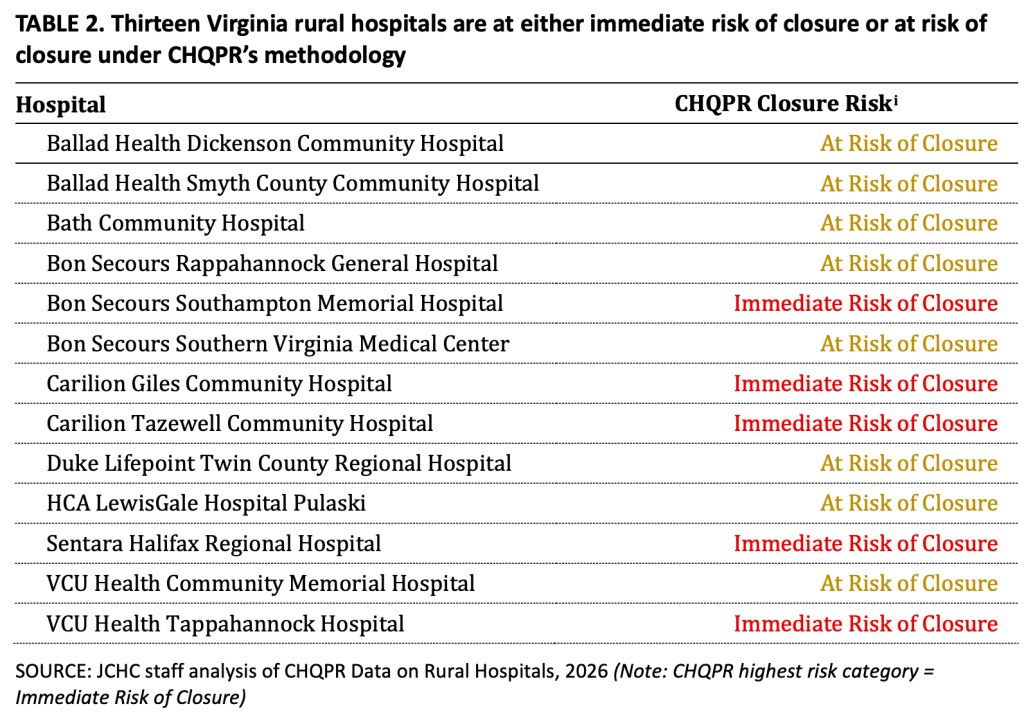
Eight rural hospitals are “at risk of closure” and five others are at “immediate risk of closure,” according to an analysis of each hospital’s financials, including operating margins and financial reserves.
A separate analysis of financial distress included in the state’s report found that four rural hospitals are in the “highest risk of distress” and eight others are in the “mid-highest risk of distress.”
“We’ve got a crisis,” said State Del. Rodney Willett (D-Henrico) at a meeting Thursday in Richmond where the report’s findings were presented.
The struggles of rural hospitals in Virginia and around the US have been an issue for years.
Since 2005, 108 rural hospitals have closed nationwide and 139 stopped offering inpatient services, according to the state report.
Rural hospitals struggle with lower numbers of patients, offer fewer services that could bring in more money, and have less negotiating power to get better reimbursement rates, the report said. Meanwhile, labor costs have gone up and inflation has driven up the prices of medical supplies.
Many patients at rural hospitals are covered by Medicare and Medicaid which don’t often reimburse hospitals enough money to cover the cost of care, the report said.
“Your findings thus far are quite scary,” State Sen. Barbara Favola (D-Arlington) said at the presentation.
One of the hospitals identified as “at risk of closure” was LewisGale Hospital Pulaski in Pulaski and is part of the HCA Virginia Health System. In a statement to Dogwood, a spokesperson for the hospital said the state’s report “may not fully reflect our hospital’s position as part of a larger healthcare network.”
“LewisGale Hospital Pulaski is not closing,” the spokesperson wrote. “We are operationally sound.”
Still, Del. Willett noted that all hospitals, big and small, profitable or otherwise, are bracing for the impact of the massive cuts to federal healthcare programs that were part of President Donald Trump’s One Big Beautiful Bill Act.
“The magnitude of this risk is unprecedented,” he said on Thursday.
The legislation has already been cited as the reason a health system closed three clinics in rural Virginia last year.
State Del. Amy Laufer (D-Crozet) said in a statement to Dogwood that “immense cuts and administrative changes in federal funding” to Medicaid and Medicare have “intensified the challenges for rural healthcare and put patients in a precarious position.”
The assurances about LewisGale haven’t been enough to ease community concerns about the hospital’s future, according to Hazel Wines, who runs a mutual aid nonprofit in Pulaski and is active in the community there. That’s partly because of what’s happening on the ground in Pulaski, but also because official statements hold less weight there than they once did.
“There’s just sort of a general erosion of trust, not necessarily with the hospital, but with anyone in an official capacity, just because things have become so unsure from the federal level down,” Wines said in an interview. “It seems like very often information that’s relayed from officials doesn’t always reflect the reality around us.”
READ MORE: Rural Virginia families like mine are crossing state lines for pediatric health care