We talked to political analyst J. Miles Coleman to get his take on the 2021 gubernatorial election in the commonwealth.
Over the past decade, Virginia has gone from being considered a Republican stronghold to a reliably blue state.
The commonwealth voted for Barack Obama in 2008 and hasn’t looked back, voting for Democratic candidates for president every year since. In 2019, Democrats took over the entire state government for the first time in more than two decades. The transition from red to purple to blue state was complete.
Then, 2021 happened.
“In politics, nothing is permanent – though Republicans had not won a statewide race in Virginia since 2009 – that dry spell was always going to end at some point. With an attractive GOP nominee and an unpopular Democratic president, enough factors fell into place for Republicans to finally claim victory.”
That’s how J. Miles Coleman, Associate Editor of Sabato’s Crystal Ball from The University of Virginia’s Center for Politics, put it. Their team, led by Larry Sabato, focuses on providing nonpartisan political analysis.
What implications will Youngkin’s win have on Virginia? There are many, but perhaps one of the biggest will be seen in Virginia’s public school system; currently ranked fourth in the entire country. Funding for public education is likely to drop if Youngkin’s administration eliminates state revenue sources and shifts money to private charter schools. Other changes could be making it harder to access abortion, adding more obstacles to voting, and eliminating or restricting greenhouse gas emissions goals that aim to prevent the severe weather produced by climate change. And yet another? Possibly helping former President Donald Trump falsely claim victory in the state if he runs again in 2024.
Youngkin’s victory does align with history. In the past, Virginia has traditionally elected a governor from the opposing party of whoever is in the White House. This trend was broken in 2013, when Democratic candidate Terry McAuliffe defeated Republican Ken Cuccinelli to become the 72nd governor of Virginia.
“Since 1977, Virginia has elected a governor from the party opposite of the sitting president. Though Virginia may still vote Democratic at the presidential level going forward, it is clear that gubernatorial elections are just different, as they have more of a local focus,” Coleman said in an interview. The gubernatorial results were “almost like a return to normalcy.”
So, what else was unique about this year’s election?
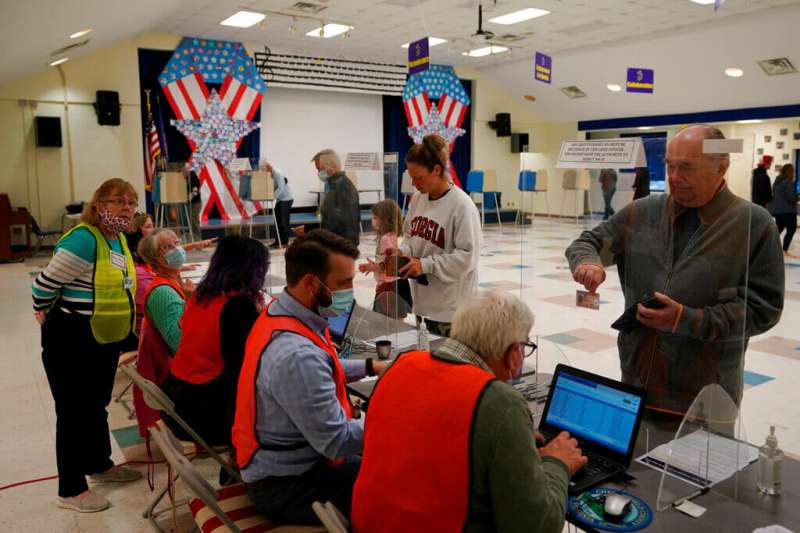
Coleman noted that about one-third of the votes – over one million votes – in this year’s election were cast early; up a considerable amount from the last gubernatorial election in 2017, where around 200,000 votes were cast early.
When led by Democrats, Virginia’s legislature in 2020 loosened some voting restrictions, removing the photo ID to vote restriction. In addition to that, voters had the option to vote absentee without an excuse. That may have had an impact on this year’s turnout. That same year, Gov. Ralph Northam signed legislation that designated Election Day as a state holiday, which could also have had an impact on the amount of voters who came out.
“[It’s] hard to tell for sure, but the fact that 25% more votes were cast this year than in 2017’s gubernatorial election may suggest it helped [turnout],” Coleman said.
Does this mean anything for next year’s congressional elections? Coleman said they looked at some recent Virginia elections and found that gubernatorial races can offer clues about the midterms. But not always.
“For instance, after now-Gov. Ralph Northam won by nine points in 2017, Democrats went on to have a good midterm. On the other hand, Terry McAuliffe’s win in 2013 didn’t foreshadow a pro-Democratic year in 2014,” he said.
The Crystal Ball team noted that in this year’s election, McAuliffe performed 12 points worse than President Biden did in 2020’s presidential election, where he [McAuliffe] lost by 2% instead of winning the state by 10%.
This year’s gubernatorial race also has the potential to shape the political landscape nationally. That’s because Gov.-elect Glenn Youngkin made education a major focus of his campaign, talking about critical race theory (which is not taught in Virginia’s public schools) with Trump base voters, but using more vague, generic language with moderates in the state.
“Youngkin did a great job of getting Trump voters to turn out for him, but he was also palatable to swingy suburban voters. Youngkin ran hard on education, so perhaps that may be a template for other Republican candidates: find a ‘pet’ issue that resonates with voters and just stick to it,” Coleman said.
A Monmouth University poll found that voters trusted Youngkin more on educational issues, even though Democratic candidates usually beat out GOP candidates on that topic.
“McAuliffe’s ‘I don’t think parents should be telling schools what to teach’ gaffe was essentially an in-kind gift to the Republicans – several GOP ads featured that soundbite,” Coleman said.
Going further back in Virginia’s gubernatorial history, Coleman also noted that back in 1997, Republican Jim Gilmore won Virginia’s governor election because “he was known for being against a car tax – that was something simple that voters remembered.”
One of the biggest surprises of the race for Youngkin’s win came from non-college-educated white voters, especially white women, who had tended to vote for the Democratic ticket in previous years.
In this year’s race, Coleman noted that Youngkin and his camp were able to “claw back” voters who had voted with Democrats in the presidential race. Youngkin also made pro-Trump areas look even redder than they had previously been, outperforming the former president in more rural areas like Southwest Virginia.
Going into the race, people thought that there would be a higher turnout that would benefit Terry McAuliffe in the end, but turnout for this race was the highest in state history.
“If exit polls are to be believed, McAuliffe ‘only’ won 18-to-29 year old voters by seven percentage points, which seemed lower than most analysts would expect. Youngkin absolutely crushed it with non-college white voters, winning that group by 52 percentage points,” said Coleman.
Overall, this year’s election was definitely one for the books, with high voter turnout in the midst of intense partisanship, showing that persuasion is still an important tool to win over voters.