Virginia Natural Resources Secretary Voyles criticizes Northam administration on Bay progress transparency
by Josh Kurtz, Virginia Mercury
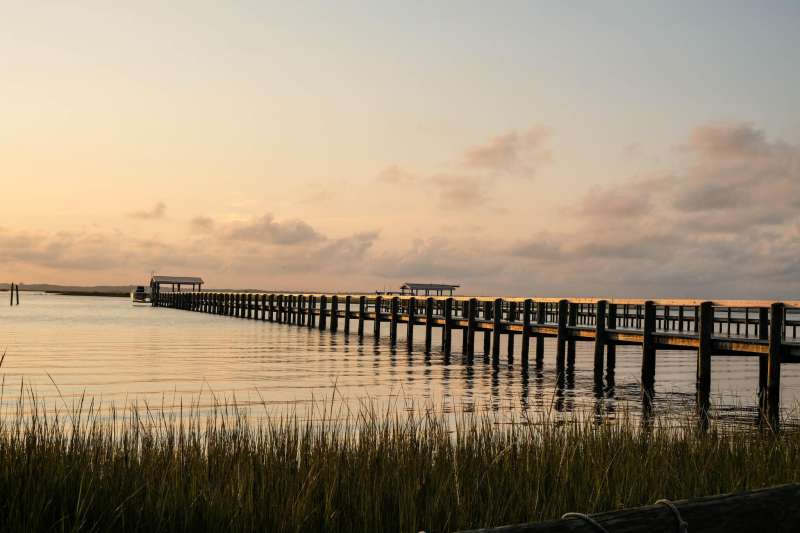
ALEXANDRIA — Amid the complicated network of land and waterways spread over six states and the District of Columbia that constitutes the Chesapeake Bay watershed, Virginia and Maryland officials gathered with environmental scientists along the banks of the Potomac River Tuesday to discuss the health of the Chesapeake Bay.
“Welcome to Virginia. But a heavy Maryland presence,” observed Virginia Secretary of Natural and Historic Resources Travis Voyles.
U.S. Sen. Chris Van Hollen, D-Maryland, acknowledged the anomaly.
“It takes a lot to get this Marylander to this side of the Potomac River,” he said. “But this occasion is one of those moments.”
The occasion was the annual release of the report card on Bay health from the University of Maryland Center for Environmental Sciences (UMCES).
The topline narrative for 2022 is that overall Bay health remains at a C, which is where it has been for the last several years. But on a variety of fronts, UMCES scientists said, Bay health is improving, and the report card helps reveal where the success stories and the challenges are.
Of the seven indicators the environmental center uses, there were improvements in water clarity, nitrogen, phosphorus and aquatic grasses. Although conditions in the Bay overall are improving, many tributaries still have poor scores, and scores are particularly bad in many Eastern Shore watersheds.
Watershed health was scored in three categories: ecological, societal and economic health. In 2022, ecological earned a B-minus, societal scored a C, and economic scored a C. Overall, the conditions across all three were worse on the Eastern Shore of Maryland and Virginia than in other regions.
Increasingly, UMCES researchers aren’t looking just at scientific data, water quality and aquatic life to assess Bay health. They’re also trying to measure how every category they study impacts the millions of people living in the Bay watershed.
“We need healthy communities to achieve a healthy Bay,” said Bill Dennison, UMCES vice president for science application.
Assigning letter grades to the health of the Bay’s waterways, land use policies and economic conditions may seem like a gimmick. But it’s also a way to get a measure of accountability from federal, state and local leaders and the various industries that impact Bay health.
“Report cards are critical for holding people accountable, but they’re also important for communicating with people,” said Josh Kurtz, secretary of Maryland’s Department of Natural Resources.
It’s also aspirational for environmental leaders, said Serena McIlwain, Maryland’s secretary of the environment.
“We’re A students,” she said. “We won’t be happy until we get all A’s.” Scores from the University of Maryland Center for Environmental Sciences report card on Chesapeake Bay health.
(The UMCES report card is one periodic assessment of Bay health. The Chesapeake Bay Foundation’s State of the Bay report card offered a D+ grade earlier this year.)
The big reveal from UMCES this year took place at the Washington Sailing Marina at Daingerfield Island in Alexandria, on property owned by the National Park Service. Planes flying in and out of Reagan National Airport threatened to drown out the speakers from time to time — and so did a few honking Canada geese.
The annual Bay report card comes as states in the watershed, along with Washington, D.C., scramble to meet federally mandated pollution reduction goals by 2025 — and most jurisdictions are expected to fall short to one degree or another. But even so, UMCES leaders said, it’s still important for states to try to reach them, and to look beyond 2025 and to next steps for improving Bay health.
“The nutrient diet is working,” Dennison said. “We just need to tighten our belts and keep improving.”
Statewide politics play a role in the health of the Bay. While a new Democratic administration in Annapolis isn’t quite five months old, in Virginia, Republicans have been running state government for the past year and a half after eight years of Democratic rule. Voyles, Virginia’s secretary of natural and historic resources, said Republican Gov. Glenn Youngkin remains committed to Bay health and conservation, and accused the administration’s predecessors of not being transparent about what it would take for Virginia to achieve its Bay cleanup goals.
“On day one, Gov. Youngkin told me, he is a conservative, and conservation is a big part of being a conservative,” Voyles said.
He also noted the absence of agricultural representatives at the event Tuesday, calling them “a key partner” in the push for better Bay health.
Voyles said the Youngkin administration is pushing to allocate 20% of the state’s discretionary spending on natural resources and restoration. “He’s really showing that this is a bipartisan issue,” he said.
On the environmental justice front
For the first time, the 2022 report card also sought to track the environmental justice challenges in the Bay watershed, which has some of the nation’s poorest areas, in cities like Baltimore, in Appalachia, and along the Delmarva Peninsula.
The index characterizes the cumulative impacts and patterns of environmental injustice across the watershed, considering such social factors such as poverty, race, ethnicity and pre-existing health conditions, which can increase these impacts. Tracked by census tract, the results were mixed.
But it will be a few years before UMCES is ready to assign letter grades on the environmental justice front or use the index to help calculate the overall health of the Bay.
“We’re not there yet,” Dennison said. “It’s new. We’re still digging into it, trying to figure out the complexity of what we’re finding.”
Van Hollen said the federal government can help pull together the cleanup goals and efforts of states and other shareholders.
“When you have a watershed that encompasses six states and the District of Columbia and knows no boundaries, it’s important that you have a federal presence,” he said.
The federal government’s Chesapeake Bay Program provides $92 million annually, and a new program within the U.S. Fish and Wildlife Service has a program that provides $8 million a year to sustain lands that surround the Bay. Additionally, the big federal infrastructure spending bill has earmarked $238 million for bay cleanup over five years.
But Van Hollen and other speakers Tuesday said climate change is jeopardizing the progress the state and federal governments are making in combating Bay pollution. He likened it to trying to run up an escalator.
“We’re running faster to stay in place with climate change,” said Martha Shimkin, deputy director of the U.S. Environmental Protection Agency’s Chesapeake Bay office, picking up on the metaphor.
This story was first published by Maryland Matters, a sister site of the Mercury within the States Newsroom network. Maryland Natural Resources Secretary Josh Kurtz is no relation to Josh Kurtz of Maryland Matters.
Virginia Mercury is part of States Newsroom, a network of news bureaus supported by grants and a coalition of donors as a 501c(3) public charity. Virginia Mercury maintains editorial independence. Contact Editor Sarah Vogelsong for questions: info@virginiamercury.com. Follow Virginia Mercury on Facebook and Twitter.