
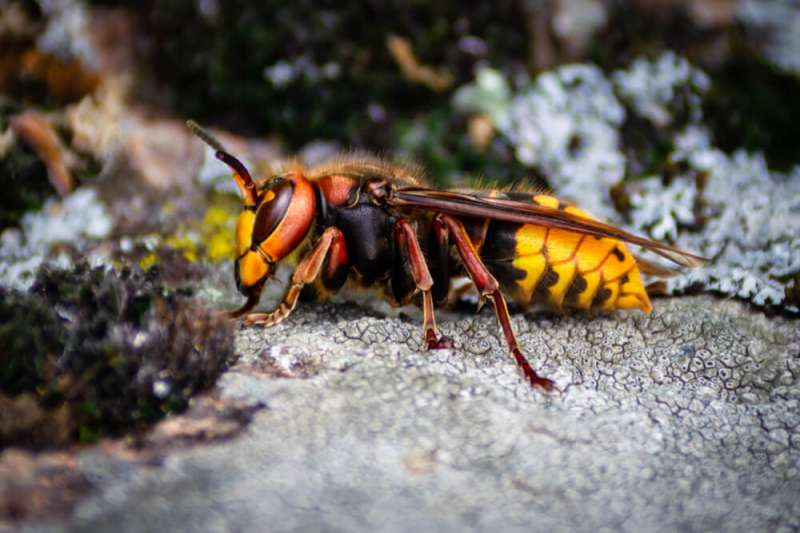
Murder hornets will soon emerge from a months-long hibernation. But no, they’re not heading this way en masse.
MARTINSVILLE – Internet memes aren’t always correct. That may come as a shock to some people, but it’s especially true in current times. They can exaggerate, stretch the truth and in some cases, just create flat out false narratives. So when you see repeated notices, all claiming that murder hornets will be arriving in Virginia by April, you’ll want to take a minute and consider the source.
No, murder hornets aren’t headed here in a swarm. They’re not responsible for any deaths in Virginia this year and they’re not “taking up residence in the Shenandoah Valley,” as one meme put it.
They’re actually pretty far away from the East Coast.
“As of now, murder hornets are just about the last thing we should worry about here in Virginia. While it’s certainly possible that these hornets could spread from Washington state, it would take them a long, long time to get here,” said Ben Williams, administrator of science at the Virginia Museum of Natural History in Martinsville. “Fortunately, major steps are being taken to control and hopefully eradicate Asian giant hornets in Washington and British Columbia. The Washington State Department of Agriculture has been extremely vigilant in monitoring the situation and destroying nests whenever they’re found.”
What Are ‘Murder Hornets’?
Okay, so the name “murder hornet” is a bit of a misnomer. If you’re a human reading this, they’re not a huge threat. If you’re a honeybee however, better start buzzing.
Williams noted that the gigantic bees aren’t actually “murder hornets” – that’s more of a nickname. The bees are actually Asian giant hornets (Vespa mandarinia)
The giant bees normally buzz around places like China, Japan, Thailand, South Korea, Vietnam and other Asian countries. Last spring, they flew onto Americans’ television screens following a Dec. 2019 discovery of a murder hornet in Washington state. Come July 2020, researchers trapped the first live murder hornet in United States history.
Over the next few months, experts set out to eradicate the invasive species. In Oct., they located and destroyed the first USA murder hornet nest, found near the Canadian border.
A Niche Threat
So why the worry about a species so far only showing up on the West Coast in America?
“The main reason that Asian giant hornets are a cause for concern is that if they spread and become established in the US, they could cause serious problems for our honeybee populations,” Williams said. “Like other wasps and hornets, Asian giant hornets are predators and mostly feed on other insects. When their colonies become large enough, they have a tendency to swarm honeybee nests and kill and eat the bees. This obviously isn’t good for honeybees.”
While one sting does not pose an innate threat to humanity, if an Asian giant hornet stung someone, it’d hurt. That’s a two-part issue. One, it’s a larger bee than most found in America. Two, they possess more venom than the average hornet.
As long as the stung individual doesn’t have a bee allergy, the venom of one sting does not contain lethal amounts.
“These hornets aren’t considered a huge threat in areas where they occur naturally. In China, for example, medical experts advise that people seek medical help if they’ve been stung more than 10 times and seek emergency treatment if they’ve been stung more than 30 times,” Williams said. “I certainly wouldn’t recommend anyone go out and get stung by a murder hornet – it’s going to result in a pretty bad day – but it isn’t a death sentence.”
Coming to Virginia?
In the Old Dominion State, an online site called Insect Identification lists 83 entries under their “Bee, Ant, Wasp And Similar Insects” category. The Asian giant hornet is not among them.
Insect Identification does, however, list the Asian horntail. That’s not the same bee as the Asian giant hornet, even though their names sound similar.
The Asian horntail is a non-native species, which first appeared in the states in the 1970s. The horntails – who prefer using trees that are already dead or dying – don’t pose a serious threat as a pest, unlike the murder hornets.
However, the threat to Virginians from the Asian giant hornet is minimal this year, unless residents travel to other parts of the county or world.
“Right now, it’s looking like the Asian giant hornet threat this year is going to be at about the same level as it was last year; that is to say, it’s a headache for the Washington State Department of Agriculture, but for the rest of us – especially those of us who don’t live in Washington state – there isn’t much to worry about,” Williams said.
JOIN THE CONVERSATION: Sign Up For Dogwood’s Newsletter
More on Identifying Species
If you see any other large bee flying around, chances are it’s not a murder hornet.
But there’s certainly room for confusion. That’s because the Asian giant hornet has a couple of cousins already in the states, besides the similar-sounding Asian horntail. And some of those kinfolk reside in Virginia.
If in doubt, try to remember identifying features and contact the experts.
“If you somehow come across an Asian giant hornet, the best thing to do would be to contact your local Department of Agriculture and report the sighting. Outside of Washington state and British Columbia, the chances of running across one are essentially nonexistent,” Williams said. “However, we do have a species in Virginia that looks a bit similar.”
That would be Vespa crabro, or the European hornet. You can thank European settlers in the 1800s for introducing that one to the continent.
“While they’re pretty scary looking, these hornets generally live out in the woods and they tend to avoid humans unless humans act aggressively toward them,” Williams said. “If you see what looks like an Asian giant hornet here in Virginia, it’s almost certainly a European hornet, or possibly an eastern cicada killer wasp (Sphecius speciosus), which is similarly mild-mannered toward humans.”
Looking Out
While murder hornets are a threat in the United States, that’s not the case everywhere.
“In their native range in Asia, Asian giant hornets can be beneficial because they often eat crop pests,” Williams said. “Unfortunately, as with most invasive species, the drawbacks far outweigh the benefits when they’re brought outside of their native range.”
However, murder hornets aren’t the only small creatures to be on the lookout for in Virginia.
“When it comes to critters in Virginia worth avoiding, the single biggest threat is likely ticks, due solely to the diseases they can carry like Lyme Disease,” Williams said. “My recommendation for folks who spend time in the woods is to get an insecticide spray containing Permethrin. You spray the stuff on your clothes and let them dry for 24 hours, and then you’re good to go. If a tick lands on clothes that have been sprayed with Permethrin, it will immediately drop off. Even better, the Permethrin stays on your clothes through multiple washes so you don’t have to worry about reapplying it every time. I’ve been using it for a couple of years now and I haven’t gotten a single tick bite.”
Critters – even the creepy, crawly, biting and stinging ones – are all a part of nature. And for Virginia’s native species, it’s simply best to learn how to live among them.
“Of course, you may also encounter different social wasps such as yellowjackets and paper wasps,” Williams said. “The best thing to do is simply leave them alone; they won’t be aggressive toward you unless you encroach on their territory or try to demolish their nests.”
Amie Knowles reports for Dogwood. You can reach her at amie@couriernewsroom.com