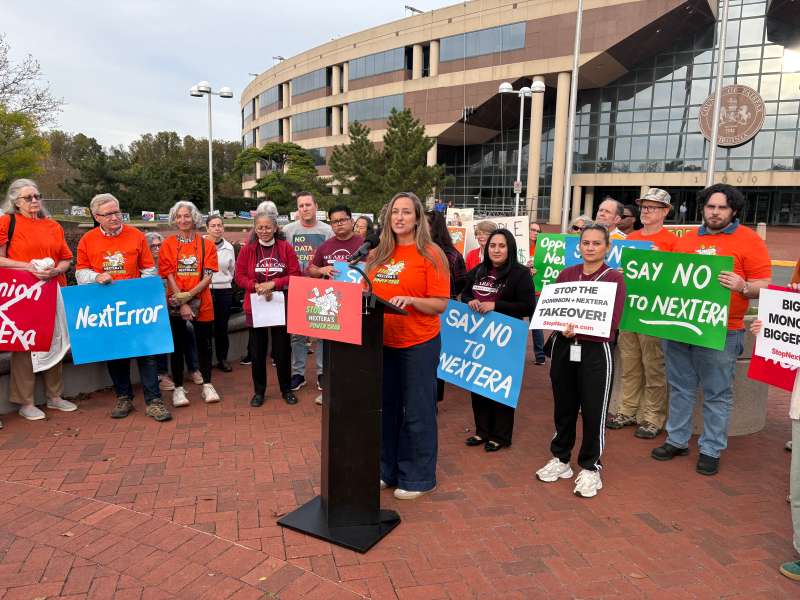
At an Oct. 9 hearing in Fairfax County, Virginia residents and state leaders made clear their frustrations with the State Corporation Commission as it reviews the proposed merger between Florida-based NextEra Energy and Dominion Energy.
It took Cindy Burbank an hour to get from her home in rural Fauquier County through heavy Friday evening traffic for the chance to speak for two minutes against the $67 billion deal that’s drawn intense scrutiny from state leaders, local governments, and residents.
Burbank’s message for the SCC commissioners—who were not actually there to hear her comments directly—was that people think they are just going through the motions in their review of the merger.
“ The vast majority of Virginians who oppose this acquisition were not here because they have no confidence that the SCC cares about their opinions,” Burbank said in an interview. “And the SCC has not made it easy for us to be here.”
Burbank, who is active with a group called Protect Fauquier, said she opposed the merger because Dominion is getting rich from the proliferation of data centers and transmission lines in Virginia at the expense of the state’s natural beauty, environment, and wellbeing of local communities.
“ It’s that powerful combination of data centers and utilities and the massive amount of money they are making that come at our expense,” Burbank said. “And that, frankly, makes me angry, and I think that’s why there’s such an uprising throughout the state of Virginia against not only data centers, but the utilities and this merger.”
NextEra and Dominion say they want to combine to be better positioned to finance and build the energy infrastructure needed to serve customers at a time of rapidly growing electricity demand. Critics of the deal, wary of allegations of political interference against NextEra, say the company is just trying to get in on the cash cow that is Virginia’s data center development—which is also undergoing a major backlash.
Those critics include Christina Farver, a climate activist from Sterling, who was at the hearing in Fairfax.
Farver didn’t think the merger would increase energy efficiency, reduce costs for residents, or protect the planet by promoting renewable energy. Farver said there aren’t enough guardrails in place to protect against a company of the size that the merger would create. She’s also concerned that a key decision maker, SCC Chair Kelsey Bagot, is a former NextEra attorney.
“I’m so sorry to say, but I have lost a lot of faith with the understanding that one of the decision makers is a former employee of one of these parties,” Farver said in an interview. “That’s crazy.”
Bagot has said she sees no reason to recuse herself from the case.
SCC spokesperson Greg Weatherford said in a statement to Dogwood that Bagot “has made it clear she has no conflict of interest whatsoever in this matter.” He said Bagot swore an oath to “faithfully and impartially discharge all the duties incumbent” upon her to make the best decisions she can on behalf of Virginia.
“An oath is a serious matter under the law,” Weatherford said. “She has made it clear she is not walking away from that solemn duty.”
Fair, transparent, and accountable?
State Del. Irene Shin (D-Herndon) testified at the Fairfax hearing in part because of her concerns about how the SCC is handling the merger case. Shin did not think the SCC scheduling a public hearing on a Friday evening on a holiday weekend was the best way to encourage civic engagement.
Shin also took issue with the SCC not pushing Dominion and NextEra to file a more detailed merger application.
“ I think that the SCC has not been transparent about their rules and their own guidelines,” Shin said in an interview. “Even if it’s not their intent, I don’t think that they’re sending a clear signal to the public that we can trust this process to be fair, transparent, and accountable.”
Shin questioned why the SCC would not extend the timeline for its review after NextEra and Dominion revised their merger proposal in September to expand on the benefits for Virginia, including additional rate relief for residents.
In a statement to Dogwood, NextEra spokesperson Neil Nissan said the company’s latest proposal reflects what it’s heard from “the governor, legislative leaders, unions and community and civic leaders on affordability, jobs and clean energy.” Nissan said NextEra’s proposal would help the state build the clean energy infrastructure it needs faster and help Virginia reduce its reliance on “expensive imported power.”
“That means good jobs, supplier opportunities, workforce investment and the kind of innovation and scale that only this combination makes possible,” Nissan said. “Between the commitments we’ve made and the long-term benefits only this combination can bring, this is good for Virginia and good for Virginians.”
The revised proposal has not swayed critics of the deal.
State Sen. Saddam Azlan Salim (D-Merrifield) said in an interview ahead of the hearing that he was encouraging people to keep raising their concerns about the merger, which he opposes. He noted that the SCC is required to read every single public comment as it makes its decision.
“You gotta voice your concern, talk to your electeds, talk to every single person out there,” Salim said. “Instead of sending one comment, go out and send 20 to 30 comments. Get every single one of your friends to do it.”
SCC response
Asked about these concerns, Weatherford, the SCC spokesperson, defended the SCC’s ability to review the NextEra-Dominion case on behalf of Virginia. He said the SCC is “an impartial, apolitical, independent regulatory agency.”
“The SCC has the resources, independence, authority and experience to review and decide a case of this magnitude and importance,” he said.
Weatherford said the chief hearing examiner is responsible for managing public hearings like the one in Fairfax.
“Every comment will be entered into the record,” Weatherford said. “Every comment will be reviewed and considered as part of the evidence in this case.”
State Del. John McAuliff (D-The Plains) testified that Virginia needs to create more separation between utility companies like Dominion and NextEra and the state leaders tasked with regulating them. The “potential juggernaut” that would be created by the NextEra-Dominion merger in a state like Virginia with lax campaign finance laws means “a ton of money may flow into the system,” McAuliff said.
“It’s up to the General Assembly to make sure that we put caps on contribution limits and we ban utilities, regulated utilities—cause it’s our job to regulate them—from donating altogether,” McAuliff said in an interview.
Dominion has been a longtime target of campaign finance reformers critical of its influence on state politics in Virginia. This year alone, Dominion has spent at least $6.1 million on political campaigns, according to Progress Virginia. At a hearing earlier this month, Virginia lawmakers grilled a NextEra executive over political interference allegations, per a Radio IQ report.
Dominion did not respond to a request for comment.
READ MORE: Newport News hosts first Dominion-NextEra merger hearing—here’s what locals said