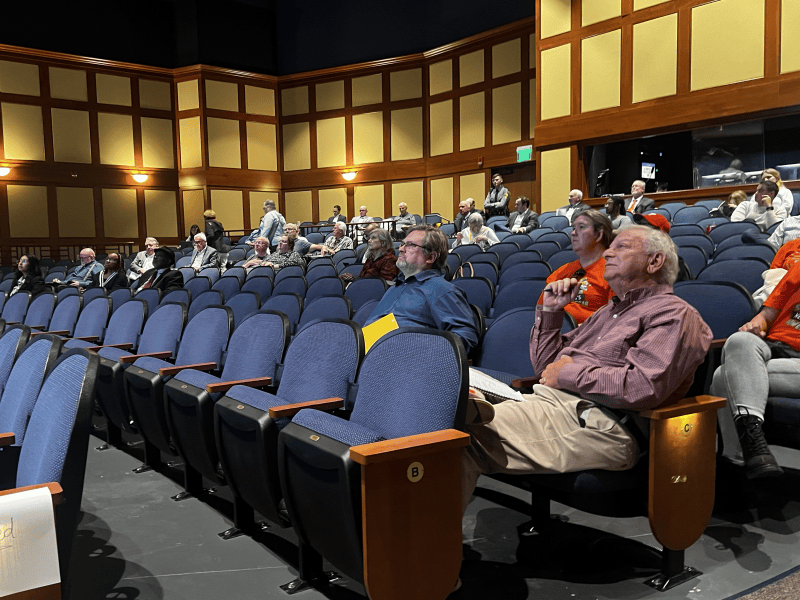
More than 30 Virginians voiced their opinions on the merger between Dominion Energy and Florida-based Next Era Energy on Wednesday, and the sentiments ranged from staunch support to firm opposition.
The Newport News gathering was the first of three public hearings held by the Virginia State Corporation Commission (SCC) regarding the $67 billion merger, which if allowed to proceed would create the largest regulated utility company in the country, serving 10 million customers across four states—Virginia, both Carolinas, and Florida.
Notably, none of the three SCC commissioners—Kelsey Bagot, Jehmal Hudson, and Samuel Towell—were in attendance at Wednesday’s hearing. Instead, all residents’ comments were documented by a court recorder and fielded by SCC Chief Hearing Examiner D. Mathias Roussy, Jr., who told them when their two minutes of allotted time were up. Roussey said that comments will be given to the SCC commissioners for review.
Merger supporters
For the first half-hour, most commenters offered support of the merger. Chris Davidson, Government Affairs Consultant of the Virginia Peninsula Chamber, spoke on behalf of the group to offer their endorsement and suggested that the merger was a path to energy growth.
“Over the past several months, our chamber has held a series of policy roundtables with employers and community leaders from across the peninsula,” Davidson said. “[Businesses] desperately need reasonable and predictable energy costs and if Virginia wants to keep on growing, we’ve got to be able to build the energy that supports that growth.”
Another supporter praised “Dominion’s longstanding commitment to Virginia customers” and “NextEra’s nationally recognized leadership and expertise in renewable energy,” while a third said NextEra’s “added resources and experience could help Virginia build a stronger and more dependable power system.”
Other supporters seemed less sure. One Virginia Beach resident approved of the merger but urged the SCC to make sure it served the public’s best interest.
“I am very optimistic, so as President Reagan once said, ‘Trust, but verify.’”
Retired engineer David Tucker said that “safety and ratepayers must be prioritized over … growing corporate jobs in Richmond,” while George Clarke of Seaford echoed his sentiment, saying that the promises the companies have made must be delivered. Those promises include “more cost-effectively” meeting electricity demand for customers, nearly $60 billion in smart capital investments, long-term affordability and reliability, and $10 rebates on utility bills for four years.
Concerns aired
Several speakers at the hearing didn’t explicitly support or oppose the merger, but expressed concerns.
“While NextEra touts that they are the largest solar developer in the country, they are also one of the largest gas developers,” said Catherine Setaro, Hampton Roads Field Manager for Virginia League of Conservation Voters. “They’re simply one of the largest energy companies in the country, if not the world, and they have a deeply troubling track record when it comes to renewables in Florida where they operate as Florida Power and Light.”
Setaro was likely referencing one of the many controversies Florida Power and Light (FPL) has been embroiled in in recent years. As Dogwood has previously reported, FPL agreed to a $150 million settlement in a class action lawsuit related to claims of the company backing ghost candidates for Florida public office, surveillance of a journalist, and using funds to influence media coverage of FPL. Setaro noted that the Virginia League of Conservation Voters had not yet taken an official stance on the merger.
Similarly, Delegate Shelly Simonds (D-Newport News) took no official position on the merger, but urged the commission to consider whether the companies could meet the requirements of the Virginia Clean Economy Act, which mandates that Dominion transition to 100% renewable energy sources by 2045. Simonds also stated her belief that Virginia customers must be shielded from natural disasters affecting NextEra’s Florida operations as well as any of their subsidiaries that currently hold debt.
Yahoo! Finance reported Tuesday that NextEra “has $110.2 billion in debt against just $2.87 billion in cash.”
Merger opponents
One Newport News resident pointed to NextEra’s securities fraud settlement and argued that not only are Virginia families still absorbing Dominion rate increases the SCC approved last year, but “industry consolidation does not serve consumers.”
Other residents decried NextEra’s historic rate hikes in Florida.
“NextEra’s aggressive capital expansion strategy … has led to massive rate hikes,” Elizabeth Paiste, a member of advocacy group Citizens for Responsible Lighting, said. “NextEra is headquartered in Florida; we need an energy company to be responsive to our needs here in Virginia.”
Software engineer Justin Davis agreed. “How does an ownership change from Virginia to Florida benefit Virginia customers?” Davis asked.
One of the final speakers of the evening was visibly incensed to the point of questioning the SCC’s motives in considering the merger.
“The fact that [this] is even allowed is crazy,” he said. “You guys should probably be investigated; I think you’re getting money from it.”
Throughout the evening, fewer speakers offered a broader or more concrete set of concerns about the merger than Newport News resident Amanda Doughty.
“You need to remember that it is the people, not the corporations, that you serve and that you are obligated to protect,” Doughty said. “Allowing Dominion management to give data centers a pass on their electricity usage so they can push the data center consumption costs onto the individual is not protecting the people. If you allow this merger to go through, you are not protecting the people—you are protecting corporations, profits, and best interests.”
In an exclusive interview with Dogwood, Doughty expanded on her position, expressing concerns about Dominion acting as a monopoly. Dominion is widely seen as a utilities monopoly since, according to its 2025 Annual Report, it serves 3.6 million customers in Virginia and the Carolinas with no competition for electric distribution service within its service territories.
“Monopolies are dangerous because there’s no other option—there’s nowhere else to take your money,” Doughty said. “That’s dangerous because if they decide to do nefarious things, you just have to put up with it. You can’t make the decision that’s best for you.”
She cited a recent power outage at Newport News Shipbuilding, which primarily gets its power from Dominion, as an example of corporate interests misaligning with the services they claim to provide.
“Dominion Energy is asking for their third rate increase this year, when—in the last quarter—they made $4.4 billion,” Doughty said. “The shipyard was out of power for a couple hours this past week because they get their energy from Dominion Energy.
“What are we doing if the Navy doesn’t have power? And if you can’t provide power to our military, how can we expect you to protect us as just a regular citizen?”
The first rate increase Doughty referenced was a base-rate increase that happened in January, while the second was a fuel-factor increase which took effect in July.
Like most Virginians, Doughty has a personal stake in the merger. As a single mother of a five-year-old, she can’t afford utility rate hikes.
“I have myself and my daughter to think of. I want to provide the best life for her,” Doughty said. “She is a competitive dancer, so that gives her an outlet to be creative and to get all of her wiggles out and to be a well-rounded individual. If I can’t afford to do the things for her that she deserves … because Dominion-NextEra just raised my rates again because the SCC said they could, that’s not fair.”
The proposed $10 monthly rebate for Dominion customers didn’t impress her, either.
“I think it’s a slap in the face,” she said, adding that she believed the credit would be canceled out by rate increases, inflation, and potentially the Regional Greenhouse Gas Initiative fee if it’s passed onto consumers.
“I think it’s insulting, I think it’s demeaning, and I think it just tells you how these two corporations feel about the constituents, which is not positive.”
SCC communications director offers insight into hearing process
In another exclusive interview with Dogwood, Greg Weatherford, Director of Communications for the State Corporation Commission, discussed the SCC’s official position on the hearings.
“It’s pretty unusual for the commission to take a case like this that is a statewide issue and set up local hearings—usually that’s reserved for issues of local interest,” he said. “The fact that the commission is going essentially ‘out on the road’ to hear what the state has to say from across the state gives you a sign of how important they think these hearings are.
“If it’s approved, it’s potentially the largest regulated utility in the world.”
Weatherford explained that once testimony is gathered, an evidentiary hearing in a Richmond courtroom will hear arguments from lawyers on all sides of the issue, including further witness testimony. Next, the SCC will review all evidence and weigh it against the law and make their decision, which is expected in January.
“Whatever happens, the regulated utility in Virginia will be regulated by Virginia according to Virginia law,” he said. “If the ownership structure changes, that does not change.”
When asked about SCC chair Kelsey Bagot, whose previous experience as a NextEra attorney has caused Virginians at the hearing—and officials like state Senator Russet Perry (D-Round Hill)—to express concerns about a potential conflict of interest, Weatherford said Bagot had shared that she didn’t plan to recuse herself.
“She presented her point of view in a letter to the general assembly and has not adjusted that position as far as I’m aware,” Weatherford said. “That position is, she said that she would recuse herself from any case in which she had a direct hand, and in this case, she has not.”
Doughty was disappointed with the SCC commissioners’ absence at the hearing.
“My expectations were that the judges were going to be here,” she said. “And the term ‘judge’ is used ceremoniously in this situation; they do not deserve to be called judges. They’re cowards, because they will not come and face the constituents and come talk to the people that they are supposed to be serving. We may not directly elect them for these positions, but we elect the people who put them in these positions, and they need to remember who they serve, and it is the people.
“And the fact that they won’t come and face the people says a lot, so I’m very disappointed that they’re not here.”
The SCC’s final order on the Dominion-NextEra merger is due on January 11.