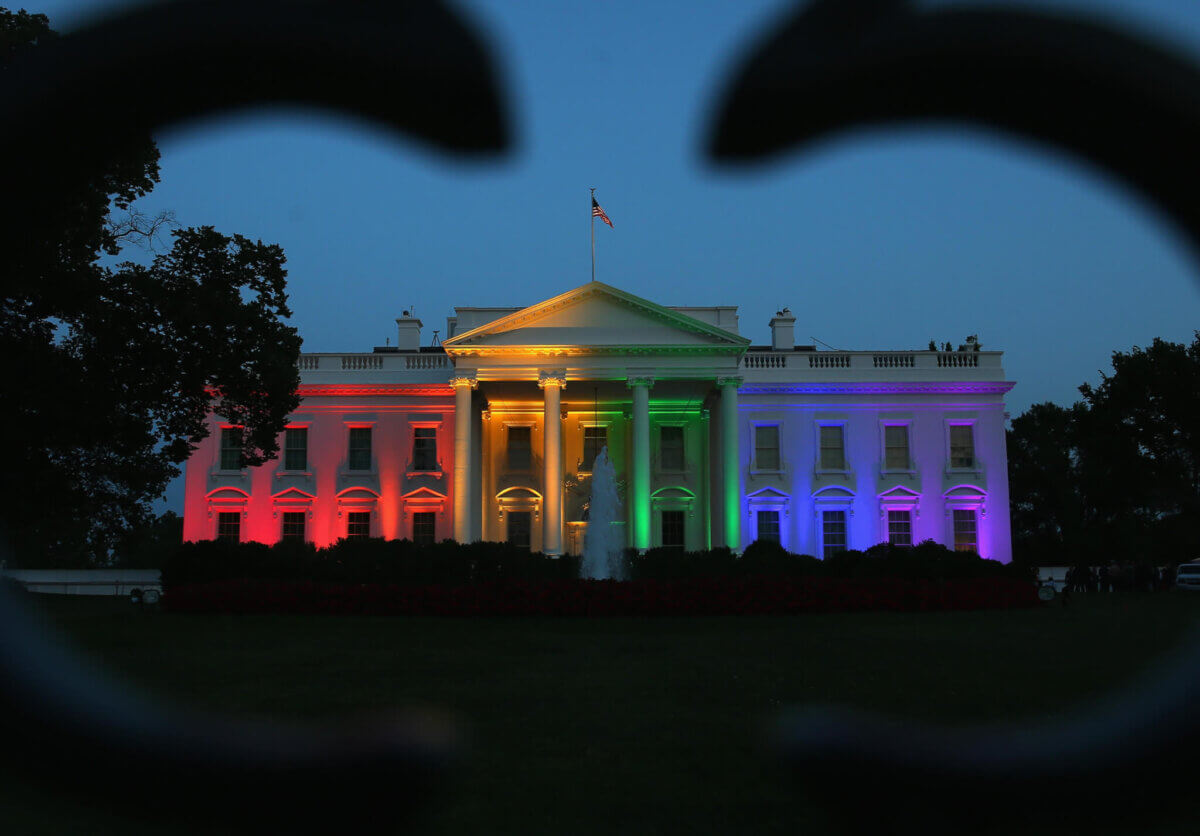
Rainbow-colored lights shine on the White House to celebrate the US Supreme Court's 2015 ruling in favor of same-sex marriage (Photo by Mark Wilson/Getty Images)
The Senate voted to pass the Respect for Marriage Act on Tuesday, a key step in protecting marriages between same-sex and interracial couples at the federal level.
The vote to pass the bill was bipartisan: 61 to 36. Every Democratic senator voted “yes,” and they were joined by a number of Republicans.
The bill’s passage comes as Democrats and LGBTQ advocates have expressed growing fear over the possibility that the landmark 2015 case Obergefell v. Hodges—which legalized gay marriage nationwide—could possibly be overturned following the Supreme Court’s decision to overturn Roe v. Wade earlier this year.
While the Respect for Marriage Act does not codify Obergefell or require states to issue marriage licenses to same-sex couples, it does require states that ban same-sex marriages to recognize these marriages as long as the marriage was valid in the state where it was performed. This would offer some protections to same-sex couples in the event that Obergefell is ever overturned and state-level bans are allowed to go into place.
The bill also protects interracial marriages by requiring states to recognize legal marriages regardless of “sex, race, ethnicity, or national origin.”
“With today’s bipartisan Senate passage of the Respect for Marriage Act, the United States is on the brink of reaffirming a fundamental truth: love is love, and Americans should have the right to marry the person they love,” President Joe Biden said in a statement celebrating the bill’s passage.
As Senate Majority Leader Chuck Schumer noted, this vote could have happened earlier this year, but more time was needed to gain support from enough Republicans to pass the bill.
The author of the bill, Sen. Tammy Baldwin, D-Wis., is the first openly gay American elected to the Senate. She recently revised the bill to garner some Republican support, adding language to clarify that religious organizations would retain the right to refuse to perform same-sex marriages and that polygamous marriages would not be protected by the federal government.
“We’re making a really positive difference in people’s lives by creating the certainty that their ability to protect their families will be lasting,” Baldwin told NBC News.
Now the bill heads to the House, where it is expected to pass, before heading to Biden’s desk for his signature. Proponents of the bill want the legislation to pass before Republicans take control of the House on Jan. 3.

Virginia House Democrats advance four constitutional amendments
The Virginia House of Delegates advanced four constitutional amendments dealing with abortion rights, gay marriage, voting rights, and...

Spanberger, Dem leaders release ‘Affordable Virginia Agenda’
Gov.-elect Abigail Spanberger released a list of bills and proposals she supports to lower the cost of health care, energy, and housing in Virginia....

Progressive Dem eyes Virginia congressional bid amid possible redistricting
State Del. Sam Rasoul of Roanoke says he supports Medicare for All, a Green New Deal, and an end to US military support for Israel. In the wake of...
Commentary: The costs of being in the majority
Democrats won on issues of affordability and working-class concerns. Now it’s time to deliver. Governor-elect Abigail Spanberger and Virginia...

Meta’s ‘teen safety’ tools are failing Virginia kids—and Gov. Glenn Youngkin isn’t helping
Parents and cybersecurity experts want Virginia lawmakers to hold companies like Meta accountable when their platforms fail to keep their pledges to...

‘Ticket to Ride’ and pickle sandwiches: The family life behind Abigail Spanberger’s campaign
Remember the viral victory speech with the toddler under the podium? That kid’s mom could be Virginia’s next governor. On Nov. 4, Democratic...