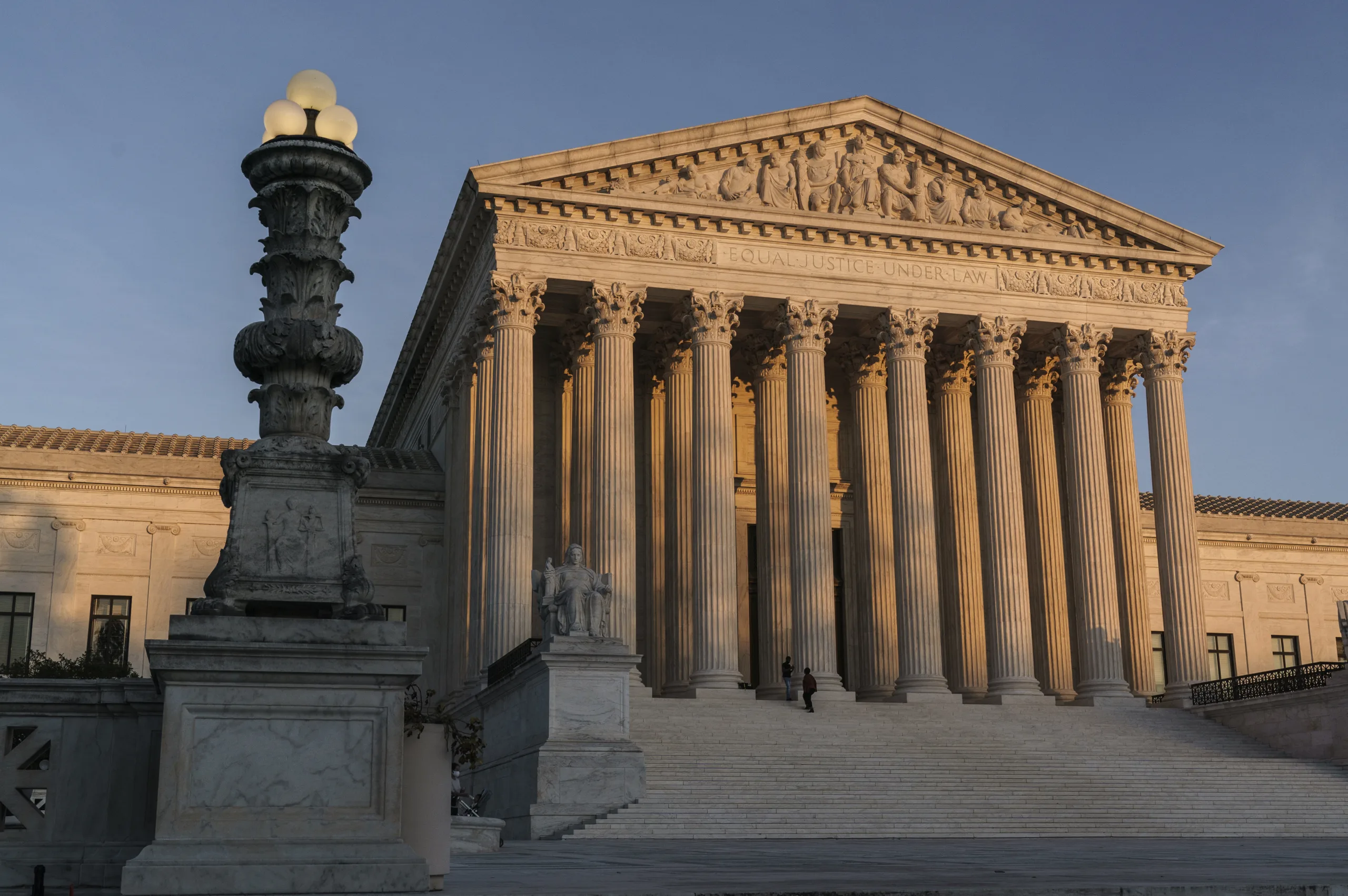
The Supreme Court is seen at sundown in Washington, on Nov. 6, 2020. (AP Photo/J. Scott Applewhite, File)
The Supreme Court agreed on Wednesday to take up a dispute over a medication used in the most common method of abortion in the United States, its first abortion case since it overturned Roe v. Wade last year.
The justices will hear appeals from the Biden administration and the maker of the drug mifepristone asking the high court to reverse an appellate ruling that would cut off access to the drug through the mail and impose other restrictions, even in states where abortion remains legal. The restrictions include shortening from the current 10 weeks to seven weeks the time during which mifepristone can be used in pregnancy.
The nine justices rejected a separate appeal from abortion opponents who challenged the Food and Drug Administration’s initial approval of mifepristone as safe and effective in 2000.
The case will be argued in the spring, with a decision likely by late June, in the middle of the 2024 presidential and congressional campaigns.
Mifepristone, made by New York-based Danco Laboratories, is one of two drugs used in medication abortions, which account for more than half of all abortions in the United States. More than 5 million people have used it since 2000.
The Supreme Court overturned the constitutional right to an abortion in June 2022. That ruling has led to bans on abortion at all stages of pregnancy in 14 states, with some exceptions, and once cardiac activity can be detected, which is around six weeks, in two others.
Abortion opponents filed their challenge to mifepristone the following November and initially won a sweeping ruling six months later revoking the drug’s approval entirely. The appeals court left intact the FDA’s initial approval of mifepristone. But it would reverse changes regulators made in 2016 and 2021 that eased some conditions for administering the drug.
The justices blocked that ruling from taking effect while the case played out, though Justices Samuel Alito, the author of last year’s decision overturning Roe, and Clarence Thomas said they would have allowed some restrictions to take effect while the case proceeded.
Women seeking to end their pregnancies in the first 10 weeks without more invasive surgical abortion can take mifepristone, along with misoprostol. The FDA has eased the terms of mifepristone’s use over the years, including allowing it to be sent through the mail in states that allow access.
In its appeal, the Democratic administration said the appeals court, the 5th U.S. Circuit Court of Appeals in New Orleans, ignored the FDA’s scientific judgment about mifepristone’s safety and effectiveness since its approval in 2000.
White House press secretary Karine Jean-Pierre said on Wednesday that the appellate ruling “threatens to undermine the FDA’s scientific, independent judgment and would reimpose outdated restrictions on access to safe and effective medication abortion.”
Lawyers for the anti-abortion medical groups and individual physicians who have challenged the use of mifepristone had urged the Supreme Court to turn away the appeals.
“The modest decision below merely restores the common-sense safeguards under which millions of women have taken chemical abortion drugs,” wrote lawyers for the Alliance Defending Freedom, which describes itself as a Christian law firm. The lead attorney on the Supreme Court filing is Erin Hawley, wife of Republican Sen. Josh Hawley of Missouri.
U.S. District Judge Matthew Kacsmaryk, an appointee of President Donald Trump in Texas, initially revoked FDA approval of mifepristone.
Responding to a quick appeal, two more Trump appointees on the 5th U.S. Circuit Court of Appeals said the FDA’s original approval would stand for now. But Judges Andrew Oldham and Kurt Engelhardt said most of the rest of Kacsmaryk’s ruling could take effect while the case winds through federal courts.
Besides reducing the time during which the drug can be taken and halting distribution through the mail, patients who are seeking medication abortions would have had to make three in-person visits with a doctor. Women also might have been required to take a higher dosage of the drug than the FDA says is necessary.
Health care providers have said that if mifepristone is no longer available or is too hard to obtain, they would switch to using only misoprostol, which is somewhat less effective in ending pregnancies.

Spanberger signs workers’ rights bills, wants changes to drug affordability board legislation
Gov. Abigail Spanberger signed several workers’ rights bills into law, but her proposed changes to legislation to create a Prescription Drug...

Richmond voter says “yes” on redistricting pushes back on Trump agenda
WATCH: This Richmonder is voting "yes" in support of Virginia Democrats’ partisan redistricting push to fight back against Trump’s agenda.

Don’t miss Virginia’s 2026 Historic Garden Week
Visit some of Virginia’s well-appointed homes and gardens during the 2026 Historic Garden Week. Spring has arrived in Virginia, and with it,...

Va. Lieutenant Governor Ghazala Hashmi urges voters to back redistricting referendum
Watch Virginia Lieutenant Governor Ghazala Hashmi explain her support for Virginia’s redistricting referendum after she voted “yes” in Richmond.

Sen. Warner: Voting ‘yes’ on redistricting referendum is best way to stand up to Trump
We caught up with Sen. Mark Warner out in Alexandria on the first day of early voting for Virginia’s redistricting referendum. Here’s why he’s...
Spanberger ends tax breaks for Confederate groups
Groups like the United Daughters of the Confederacy are losing their tax exemptions. Gov. Abigail Spanberger on Monday signed into law legislation...