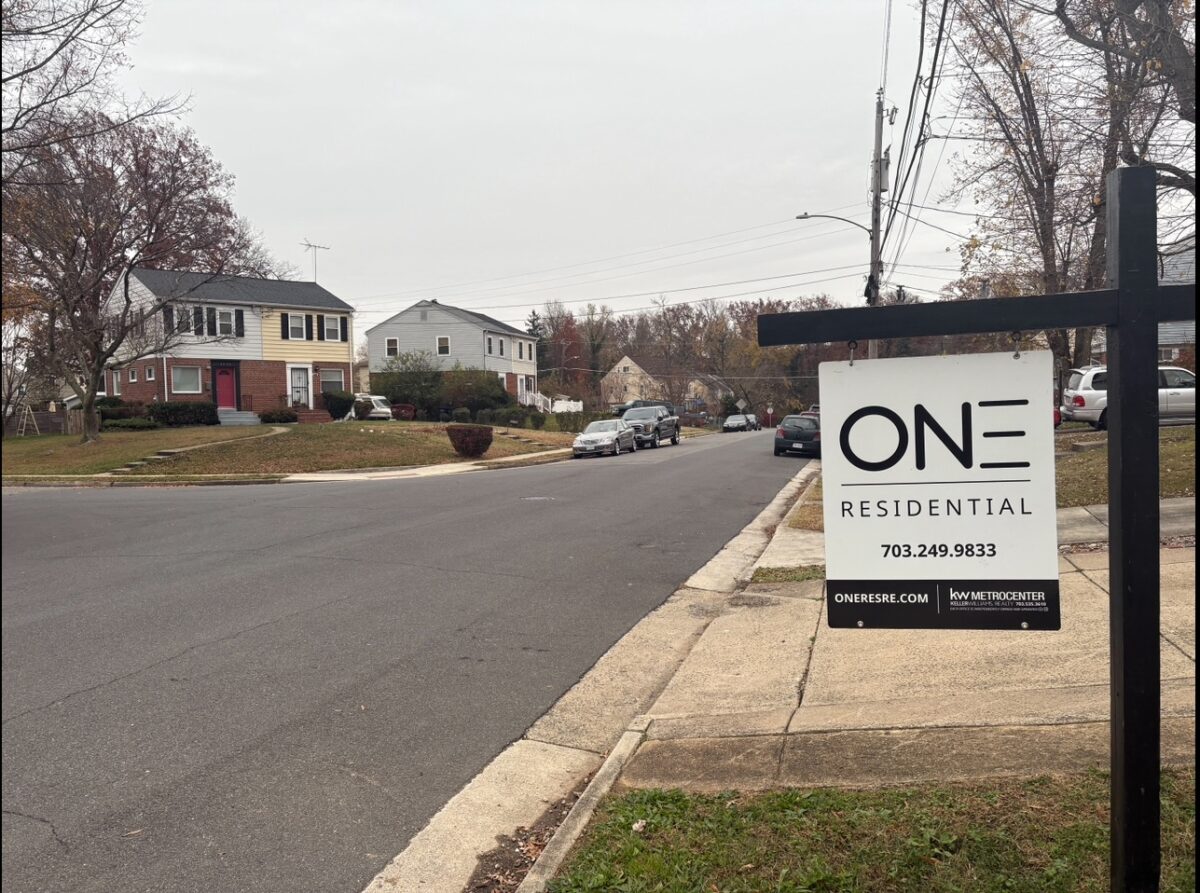
A residential street in Alexandria (Fairfax County) on November 20, 2025. (Michael O'Connor/Dogwood)
Virginia lawmakers hope the election of Abigail Spanberger to the Governor’s Mansion will breathe new life in the fight to address the state’s housing crisis.
In the wake of an election cycle where Democrats’ focus on affordability carried the day, housing featured prominently in the conversation around Virginia’s high cost of living.
Now, as state politics shifts its focus from policy promises to policy making, a clearer picture is emerging on how Democrats plan to deliver on their pledge to address the state’s housing crisis.
Democrat Gov.-elect Abigail Spanberger made increasing the supply of affordable housing a centerpiece of her campaign platform.
“We’re going to lower the cost of renting, buying, or staying in your home,” Spanberger said in her victory speech earlier this month. “We are going to cut red tape and build homes families can actually afford.”
Spanberger did not immediately respond to a request for comment for this story, but Democrats elected to the House of Delegates, many of whom also ran on addressing housing costs, are now gearing up to tackle housing affordability when the General Assembly meets in January.
Addressing supply
State Sen. Jennifer Carroll Foy (D-Woodbridge) told Dogwood she plans to introduce legislation called Yes In God’s Backyard, also known as the Faith in Housing bill, that would let faith groups build affordable housing on their property.
“What that bill does is allow faith-based organizations to bypass a lot of the bureaucratic red tape in order to build accessible and affordable housing on their property,” Carroll Foy said in an interview.
And there will also likely be legislation that lets homeowners build smaller, additional units on their properties, known as accessory dwelling units, said Laura Dobbs, director of policy at Housing Opportunities Made Equal of Virginia (HOME of Virginia).
“We need to build more housing while also increasing our investment in affordable housing,” Dobbs said in an interview.
HOME of Virginia estimates Virginia’s housing market is short roughly 300,000 homes, a figure that includes affordable rental housing and housing stock for home buyers.
The lack of supply is driving up rents and the costs of buying. The median sales price for a home in Virginia was $430,000 in October, up $15,000 from the same time last year—an increase of 3.6%, according to a report from Virginia REALTORS.
Preserving existing units
Beyond expanding supply, there’s also a need to prioritize the preservation of Virginia’s existing affordable housing stock, said Isabel McLain, director of policy and advocacy at the Virginia Housing Alliance.
To this end, state Del. Elizabeth Bennett-Parker (D-Alexandria) filed legislation aimed at properties developed through the federal Low-Income Housing Tax Credit (LIHTC) program that requires rent restrictions to keep the units affordable. Bennett-Parker declined to be interviewed for this story.
Her bill, which has been vetoed three times by outgoing Republican Gov. Glenn Youngkin, a former private equity executive, would allow localities to pass ordinances that give them what’s called a right of first refusal on certain affordable housing properties.
Properties that qualified for the LIHTC program did so on the condition their units remain affordable for a set time period. For many properties in Virginia and around the country, that window where they have to remain affordable is coming to a close, McClain said.
When that window ends, the owners are free to do whatever they like with their properties, including turning them into market-rate developments that leave low-income renters scrambling to find new homes.
Bennett-Parker’s bill would enable local governments to come up with a plan to make sure the units remain affordable. Localities could pass ordinances that let them be first in line to buy the properties or work with a third-party on a plan to keep the units affordable.
“The right of first refusal would give localities the authority to have the right to buy that building before any other buyers come in as it’s rolling off its affordability period,” Dobbs said. “Or they could transfer that right to an affordable housing nonprofit who will buy the building and preserve that affordability to prevent it from converting to market rate.”
In Virginia alone, there are over 13,000 units of federally-assisted homes that are at risk of their affordability expiring over the next five years, McLain said.
“The vast majority of affordable projects—especially those that are in areas of opportunity where we need affordable housing the most—they are absolutely not going to stay affordable after the rent restrictions end,” McLain said. “So all of the tenants there would be displaced.”
There are some existing ways and incentives for these properties to have their status as affordable housing extended, but a more comprehensive approach is needed, McLain said.
“We are already losing units, but we are facing a bigger wave that we absolutely need more tools to be ready for,” McLain said.
Correction: A previous version of this story incorrectly referred to the name of a bill. The Yes in God’s Backyard legislation is also known as the Faith in Housing bill.

Support Our Cause
Thank you for taking the time to read our work. Before you go, we hope you'll consider supporting our values-driven journalism, which has always strived to make clear what's really at stake for Virginians and our future.
Since day one, our goal here at Dogwood has always been to empower people across the commonwealth with fact-based news and information. We believe that when people are armed with knowledge about what's happening in their local, state, and federal governments—including who is working on their behalf and who is actively trying to block efforts aimed at improving the daily lives of Virginia families—they will be inspired to become civically engaged.

‘Worse than COVID’: Local Virginia leaders urge action in response to federal funding cuts
“We got through COVID because we had a lot of federal support,” said Fairfax County Board of Supervisors Chairman Jeffrey McKay. “We will get no...

Experiencing housing insecurity in Chesapeake? Check out these resources
Discover Chesapeake's comprehensive network of homeless support services, from crisis intervention to long-term housing solutions and daily...

From rural to riches: Exploring the transformation of NoVA’s housing market
Did you know that Virginia ranks among the wealthiest states in America? We’re looking at some of the places people call “home” in Northern...

Virginia legislators eye anti-rent gouging, zoning changes to address housing challenges
With studies showing Virginia short thousands of units, legislators and advocates hope to find common ground to address the state’s ongoing housing...

Walz and Vance offer wildly different visions for how to solve America’s housing shortage
During Tuesday’s vice presidential debate, Tim Walz highlighted the importance of building more affordable homes for families and holding...

Richmond uses Biden-Harris funds to build affordable housing
While Richmond struggles with a shortage of 11,000 affordable homes, the city is advancing plans to build 2,296 rental homes for people living near...