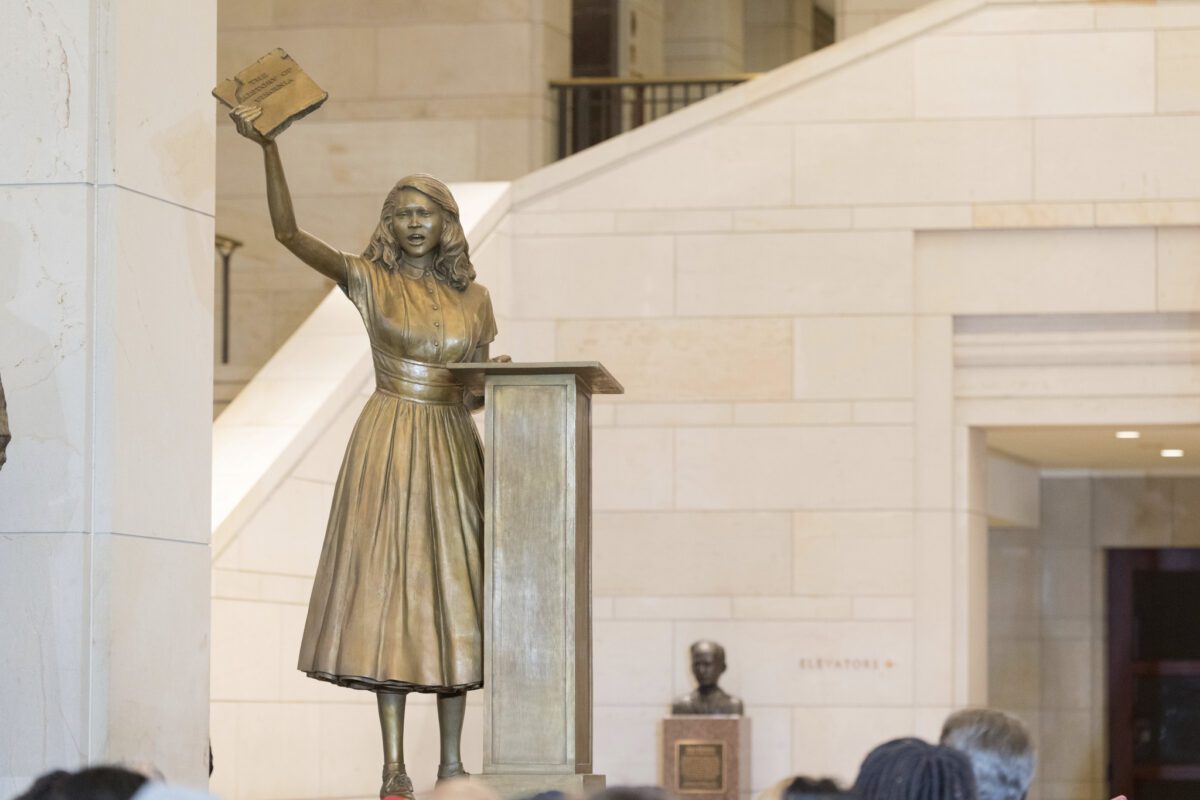
The statue of Barbara Johns now stands tall inside the US Capitol. (The Office of Sen. Mark R. Warner)
Barbara Rose Johns, who led a walkout of her segregated VA high school in 1951, was immortalized with a new statue in the US Capitol. It replaces one of Robert E. Lee.
On Tuesday, one of Virginia’s Civil Rights icons, Barbara Rose Johns, was cemented in history at the US Capitol. Johns was a teenager when she organized a walkout of her segregated high school in 1951. Now, a statue of her protesting and raising a book over her head has been unveiled for the Capitol’s National Sanctuary Collection. It replaces one of Confederate General Robert E. Lee.
The statue of Johns is engraved with an important quote that reads “Are we going to just accept these conditions, or are we going to do something about it?” Doing something about unacceptable conditions was the only option for the Virginia teenager, who sought to create a better environment for herself and her peers. The idea to immortalize Johns in the US Capitol originally came from a state commission that recommended her as a replacement after former Democratic Virginia Governor Ralph Northam proposed to remove the statue of Lee in December 2020, which was meant to represent the state of Virginia.
Speaking at the statue’s unveiling ceremony, which was held in Emancipation Hall, Democratic Minority Leader Hakeem Jeffries said, “The Commonwealth of Virginia will now be properly represented by an actual patriot who embodied the principle of liberty and justice for all, and not a traitor who took up arms against the United States to preserve the brutal institution of chattel slavery.”
Republican House Speaker Mike Johnson, who was also in attendance, said, “We are here to honor one of America’s true trailblazers, a woman who embodied the essence of the American spirit in her fight for liberty and justice and equal treatment under the law, the indomitable Barbara Rose Johns.”
Around 200 members of her family were there for the ceremony, which included a performance of “Total Praise,” “How Great Thou Art,” and “Ain’t Gonna Let Nobody Turn Me ‘Round” by Washington’s Eastern Senior High School choir.
Barbara Rose Johns was 16 years old when she led a school walkout in Virginia
In 1951, 16-year-old Barbara Rose Johns attended Farmville’s segregated R.R. Moton High School. She became increasingly frustrated by the school’s single-story building and its inability to properly accommodate the hundreds of students in attendance there. Some classes were held in tarpaper shacks, even in the winter, and the school didn’t have a cafeteria, gym, or laboratories. In comparison, an all-White school nearby was more spacious and had two stories available for fewer than 400 kids.
Johns confided in her music teacher about her frustration, and then wrote about their conversation later in her diary. “I told her it wasn’t fair that we had such a poor facility, equipment, etc,” Johns wrote. She added that the teacher “paused for a few moments and asked, ‘Why don’t you do something about it?’ I was surprised at her question, but it did not occur to me to ask what she meant. I just slowly turned away, as I felt she had dismissed me with that reply.”
Then, Johns began to take her teacher’s words to heart, coming up with the idea “to go on strike. We would make signs, and I would give a speech stating our dissatisfaction, and we would march out of the school.” She, alongside 450 of her classmates, did exactly that. They led a walkout to protest for better school conditions. Johns wrote in her diary later that many students expressed fear over being arrested because of their actions, to which she told them, “The Farmville jail isn’t big enough to hold us.”
Shortly after their strike, lawyers from the NAACP decided to file a lawsuit on the students’ behalf. That case, along with four others, became the foundation for the US Supreme Court’s landmark decision in Brown v. Board of Education in 1954. Their decision stated that segregated schools were “inherently unequal,” and that the common ideology of “separate but equal” was unconstitutional.
For Johns, giving back to others was a lifelong pursuit. She and her husband, Reverend William Powell, had five children together. She worked as a librarian for the Philadelphia Public Schools system until 1991, when she died of bone cancer at the age of 56.
You can read more about her life and legacy here.
The statue is part of the US Capitol’s National Sanctuary Hall Collection
The new statue of Barbara Rose Johns is part of the US Capitol’s National Statuary Hall Collection, which houses two statues representing each state. For Virginia, that previously included one of George Washington and one of Robert E. Lee until Lee’s was removed in 2020. Johns’s statue in the US Capitol was sculpted by Maryland’s Steven Weitzman.
For Richmond residents who want to pay their respects to Johns but are unable to travel to the US Capitol, there’s an existing statue of her at the Virginia Civil Rights Memorial located outside the state Capitol building. As for Johns’s former high school? It was transformed into a museum and has since become a National Historic Landmark.
Speaking of the museum, Governor Glenn Youngkin said, “It’s an incredibly profound moment, a moment to stand in a tar shack classroom with a hot potbelly stove as a heater, tar paper walls, shabby desks, right where 16-year-old Barbara Rose Johns courageously organized her schoolmates and stood up to the lie — the lie was separate but equal.”
This article first appeared on Good Info News Wire and is republished here under a Creative Commons license.
Related: A daily journey through Virginia’s Black history: From Civil Rights to cultural icons


Why health insurance is so expensive this year — and what you can do about it.
Michelle Andrews November 4, 2025 This year’s Obamacare open enrollment period, which started Nov. 1 in most states, is full of uncertainty and...
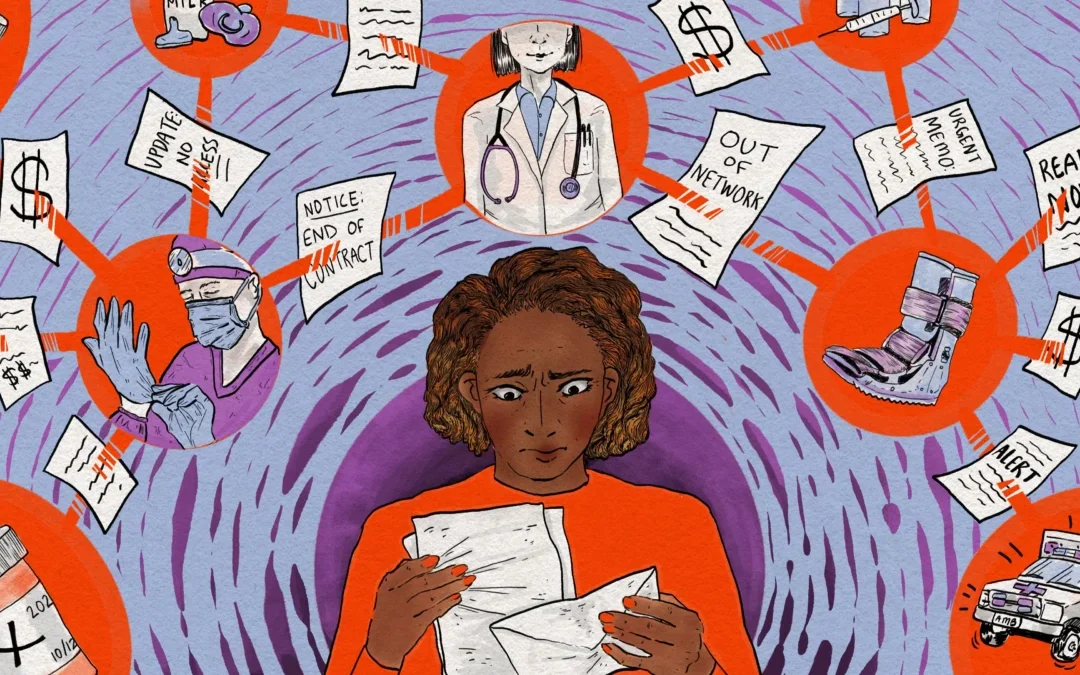
So your insurance dropped your doctor. Now what?
Bram Sable-Smith and Oona Zenda Illustrations by Oona Zenda October 29, 2025 Last winter, Amber Wingler started getting a series of increasingly...

Time’s running out for VA heating system tax credits
Learn how to take advantage of the Inflation Reduction Act tax credits in Virginia by installing an energy-efficient heating system. As...

More Virginians leaving leaves, a boon for sustainability, survey finds
By Zamone Perez More Virginians are leaving leaves on the ground during the autumn season, providing a boon to local ecosystems and cutting...

The Social Security Administration is no longer issuing paper checks. Here’s what you need to know
The Social Security Administration (SSA) has switched to electronic forms of payment. Here’s how you can set up your automatic payments with ease....

Rate of uninsured children up in VA as pandemic-era protections end
By Zamone PerezThe rate of children without health insurance grew in Virginia and across the country, hitting its highest levels in more than a...