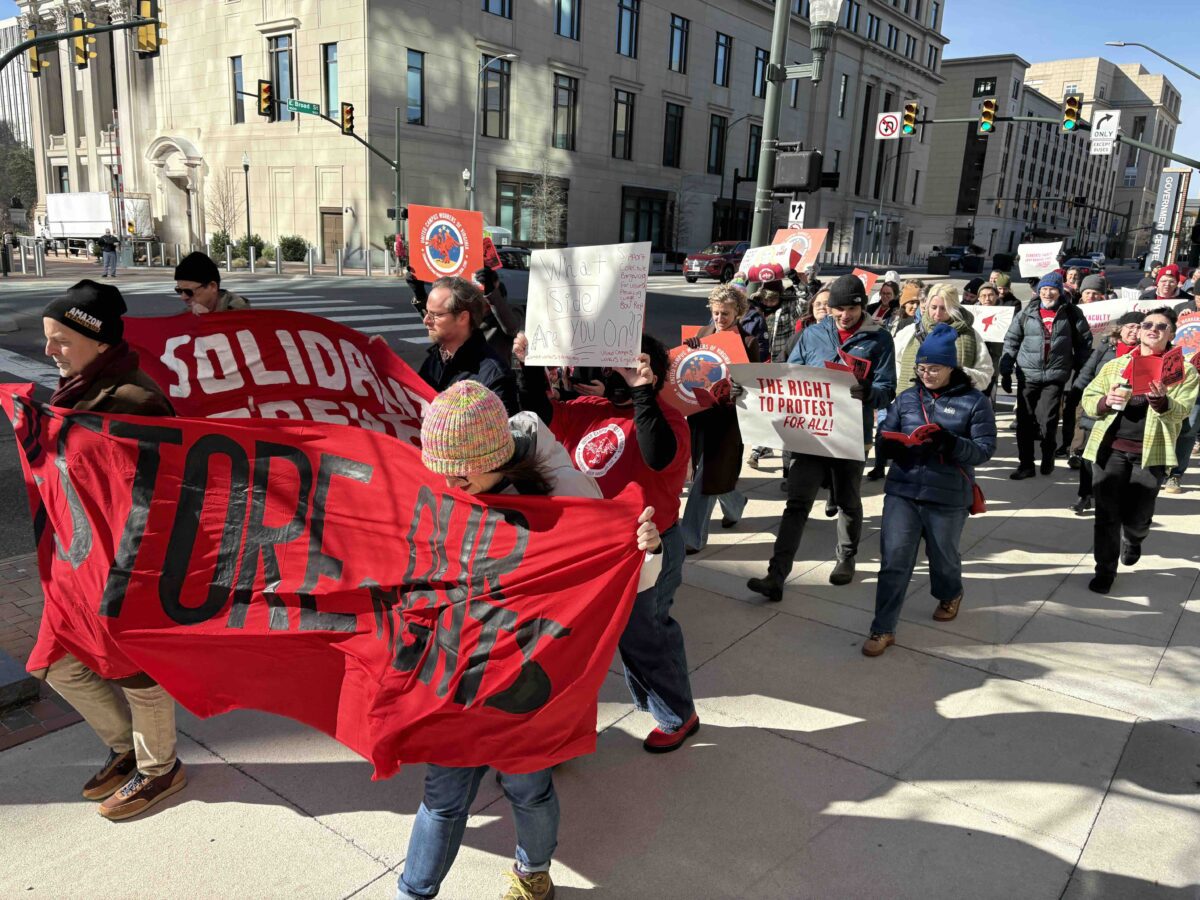
Campus workers marching in downtown Richmond on January 16, 2026. (Michael O'Connor/Dogwood)
Former Gov. Glenn Youngkin last year blocked legislation that would give collective bargaining rights to public sector workers. Now, some of those workers are pushing Democrats to get the job done this year.
Higher education workers are keeping up the fight to win collective bargaining rights as part of a decades-long struggle that dates back to the Jim Crow era.
United Campus Workers of Virginia, a union with chapters at four of the state’s public universities, held a rally last week in Richmond as part of what its members hope is the final push to get public sector workers collective bargaining rights.
“The Democrats won big in November, now it’s time to deliver and sign a strong collective bargaining bill,” Gabriel Costello, a graduate student and instructor at the University of Virginia, said in an interview.
Bills in the House of Delegates and Senate aim to do just that by lifting the ban on collective bargaining for state employees and expanding collective bargaining rights to all local employees, including public school teachers and local firefighters.
Gov. Abigail Spanberger hasn’t said where she stands on public sector bargaining, but she has said she wants to make Virginia the “best state for business and the best state for working families.”
Costello and his fellow campus workers believe that Virginia should make it legal for public sector workers like them to engage in collective bargaining with their employers to win better pay, benefits, and working conditions.
Costello lives paycheck to paycheck as a graduate student and instructor at UVA. He had to skip a relative’s funeral because he couldn’t afford the travel costs.
“My employer is one of the wealthiest universities in the world,” Costello said. “There’s no reason we should have to live like this.”
Slow progress
Virginia’s restrictions on campus workers’ rights is commonly viewed as beginning at UVA in 1943, when 28 Black women employed at the UVA hospital staged a walkout over their low pay. They were fired for their walkout, but UVA ultimately re-hired them with better pay.
Three years later, the General Assembly passed a joint resolution prohibiting state agencies from recognizing public employee unions. In 1977, the Virginia Supreme Court ruled that public sector workers cannot negotiate contracts with their employers, and the ban on public sector bargaining in Virginia was codified in 1993.
In 2020, former Gov. Ralph Northam signed into law legislation that let local municipal and public school employees engage in collective bargaining if their local governments or school boards passed resolutions allowing them to do so.
Nearly twenty localities or school boards, including in Charlottesville and Fairfax County, have passed measures to let their workers engage in collective bargaining. At least one—the Manassas City School Board—has banned collective bargaining.
Last year, Democrats in control of the General Assembly passed legislation to expand collective bargaining rights to all state and local employees, but former Gov. Glenn Youngkin vetoed the bill.
Rodrigo Soto of The Commonwealth Institute for Fiscal Analysis said that public sector workers typically make less than they otherwise would in the private sector. Putting them in a position to negotiate for better pay and support would help reduce turnover and improve the work they do.
“Public sector workers in Virginia are being underpaid,” Soto said in an interview. “And that harms the quality of services that all of us rely on.”
Collective bargaining won’t solve all the problems at UVA, or at any other workplace for that matter, but it would strengthen workers’ ability to address them, Andy Gneiting, a recycling worker, said at last week’s rally in Richmond.
“ When we grad students, professors, and staff members have a seat at the table and can have a meaningful say in our workplace, we can make our workplaces strong,” Gneiting said.

Support Our Cause
Thank you for taking the time to read our work. Before you go, we hope you'll consider supporting our values-driven journalism, which has always strived to make clear what's really at stake for Virginians and our future.
Since day one, our goal here at Dogwood has always been to empower people across the commonwealth with fact-based news and information. We believe that when people are armed with knowledge about what's happening in their local, state, and federal governments—including who is working on their behalf and who is actively trying to block efforts aimed at improving the daily lives of Virginia families—they will be inspired to become civically engaged.

Virginia General Assembly passes overtime pay for live-in nannies, housekeepers
The legislation would allow live-in domestic workers and home care workers to earn overtime pay. On Tuesday, the Virginia House of Delegates passed...
Virginia home care workers fight for collective bargaining rights
A bill that would lift Virginia’s ban on public sector bargaining may exclude underpaid and in-demand home care workers. They’re fighting back. Her...
Virginia lawmakers pass bills to expand collective bargaining rights to public workers
Each chamber of the Virginia General Assembly passed different versions of a bill that would lift the ban on collective bargaining for state...

Virginia Senate committee advances slate of pro-worker bills
The committee advanced a bill to repeal Virginia’s ban on public sector collective bargaining, as well as legislation to prevent heat illness on the...

Virginia House passes $15 minimum wage
Democratic Gov. Abigail Spanberger supports the effort, making it likely she will enact the legislation once it reaches her desk. The Virginia House...
Virginia groups join call for nationwide general strike on Friday
The killing of Renee Good and Alex Pretti this month by federal immigration agents have galvanized the movement fighting back against President...