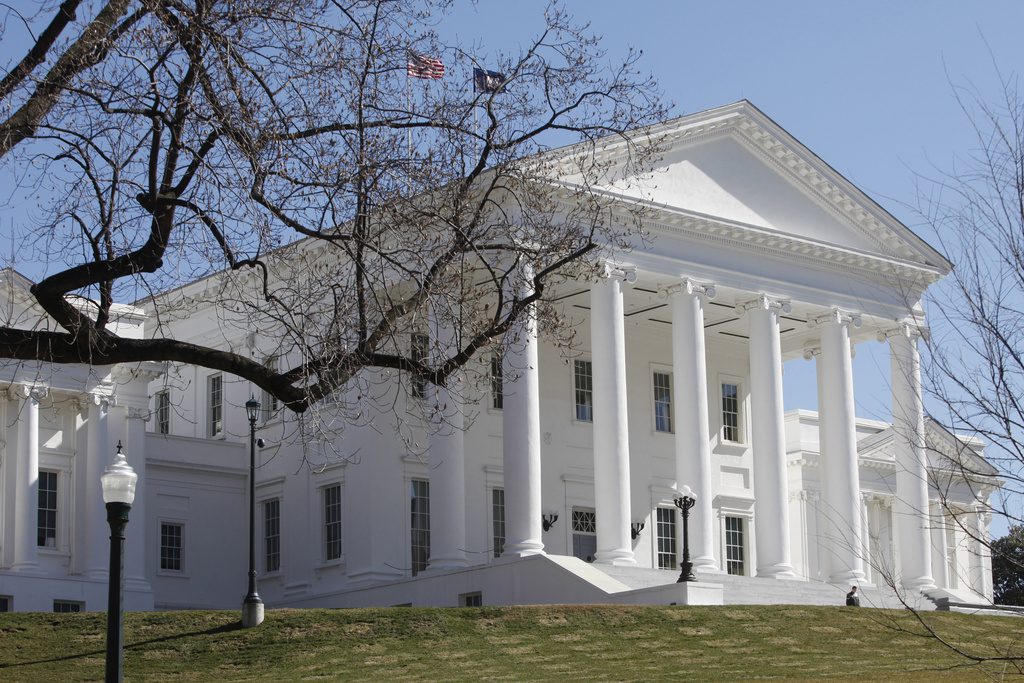
The Virginia Capitol is seen March 4, 2010, in Richmond, Va. (AP Photo/Steve Helber, File)
As Virginia’s General Assembly legislation approaches the halfway point, lawmakers have passed measures to strengthen tenants’ rights and to increase the supply of affordable housing.
Virginia Democrats in both Legislative chambers passed a number of bills this month to increase the supply of housing and support tenants’ rights.
The Virginia Senate has passed a slew of housing-related bills, including ones that extend the time tenants have before they can be evicted and give localities more zoning flexibility to increase affordable housing options.
“This session, Senate Democrats are taking action to protect Virginians by increasing transparency, providing more notice for lease terminations, and ensuring eviction processes are fair,” Senate Democrats said in a statement Tuesday.
Virginia House Democrats released a statement of their own Tuesday, touting their passage of “commonsense housing bills focused on lowering housing costs.”
Those bills include House Bill 1005, which passed on Monday and bans unnecessary maintenance fees and requires landlords to accept payments by any lawful means, including check, debit or credit card, and cash. House Bill 1093, which caps excessive attorney fees when tenants catch up on rent before an eviction court date, also passed the House on Monday.
A top priority for Virginia Democrats, House Bill 4, aims to help localities preserve their stock of affordable housing, passed in the House last week and has been referred to a Senate committee. It’s one of the bills Democratic Gov. Abigail Spanberger included on her list of “Affordable Virginia Agenda” legislation.
“I look forward to continuing to work with General Assembly leadership to make sure I can sign every piece of our Affordable Virginia Agenda into law,” Spanberger said in a statement on Monday.
Spanberger also included House Bill 15, which passed the House last week, and its Senate companion bill on that list: the legislation would extend the amount of time tenants have to respond to an eviction filing from five days to 14 days
Housing, the biggest monthly expense for most Americans, is one of the key ways that Americans are feeling the pinch of the high cost of living, and it’s a crisis in the US and Virginia that’s been years in the making.
Virginia Democrats from the top of the ticket on down campaigned hard last year on making housing more affordable.
Laura Dobbs, director of policy at Housing Opportunities Made Equal of Virginia (HOME of Virginia), said housing is increasingly a “huge affordability problem.”
“More and more people are feeling the squeeze is why it’s finally risen to be an election issue and finally something that hopefully the legislature actually does something about,” Dobbs said.
Another bill, House Bill 854, passed in the House with unanimous, bipartisan support. It’s a technical bill, but essentially the legislation clarifies that localities can exempt nonprofits from paying real estate taxes on affordable housing properties they control.
Isabel Mclain, director of policy and advocacy at the Virginia Housing Alliance, said the bill could have a big impact in localities that choose to act on it given that a lot of Virginia’s affordable housing is controlled by nonprofits.
“We’ve seen property taxes increase a lot with all the inflation of recent years, and it’s causing a lot of our nonprofit housing providers to go in the red each year,” McLain said. ‘“And it means that they have less finances to cover resident services or do maintenance.”
Not every housing-related bill is seeing smooth sailing.
A bill to protect the rights of unhoused people was put on hold for the second year in a row. House Bill 1394 would prevent localities from imposing a civil or criminal penalty on unhoused people for basic activities like resting or shielding themselves from the cold in public because they have nowhere else to go.
McLain could not say why the bill struggled to gain traction, but guessed it’s possible larger concerns about state versus local authority could have been on lawmakers’ minds.
But in the shadow of a 2024 US Supreme Court ruling that got rid of guardrails for how localities treat their unhoused population, it’s important to create state-level legal protections for people with no alternatives, McLain said.
“We feel like it’s really important that in state code we recognize that people experiencing homelessness have the same rights to exist in public places, and that they, by existing, are not automatically a threat to safety,” McLain said.

Support Our Cause
Thank you for taking the time to read our work. Before you go, we hope you'll consider supporting our values-driven journalism, which has always strived to make clear what's really at stake for Virginians and our future.
Since day one, our goal here at Dogwood has always been to empower people across the commonwealth with fact-based news and information. We believe that when people are armed with knowledge about what's happening in their local, state, and federal governments—including who is working on their behalf and who is actively trying to block efforts aimed at improving the daily lives of Virginia families—they will be inspired to become civically engaged.

Spanberger rolls out housing affordability plan
The Democratic nominee for governor wants Virginia to become the national leader in addressing the housing affordability crisis by increasing the...
‘Worse than COVID’: Local Virginia leaders urge action in response to federal funding cuts
“We got through COVID because we had a lot of federal support,” said Fairfax County Board of Supervisors Chairman Jeffrey McKay. “We will get no...

Experiencing housing insecurity in Chesapeake? Check out these resources
Discover Chesapeake's comprehensive network of homeless support services, from crisis intervention to long-term housing solutions and daily...

From rural to riches: Exploring the transformation of NoVA’s housing market
Did you know that Virginia ranks among the wealthiest states in America? We’re looking at some of the places people call “home” in Northern...

Virginia legislators eye anti-rent gouging, zoning changes to address housing challenges
With studies showing Virginia short thousands of units, legislators and advocates hope to find common ground to address the state’s ongoing housing...

Walz and Vance offer wildly different visions for how to solve America’s housing shortage
During Tuesday’s vice presidential debate, Tim Walz highlighted the importance of building more affordable homes for families and holding...