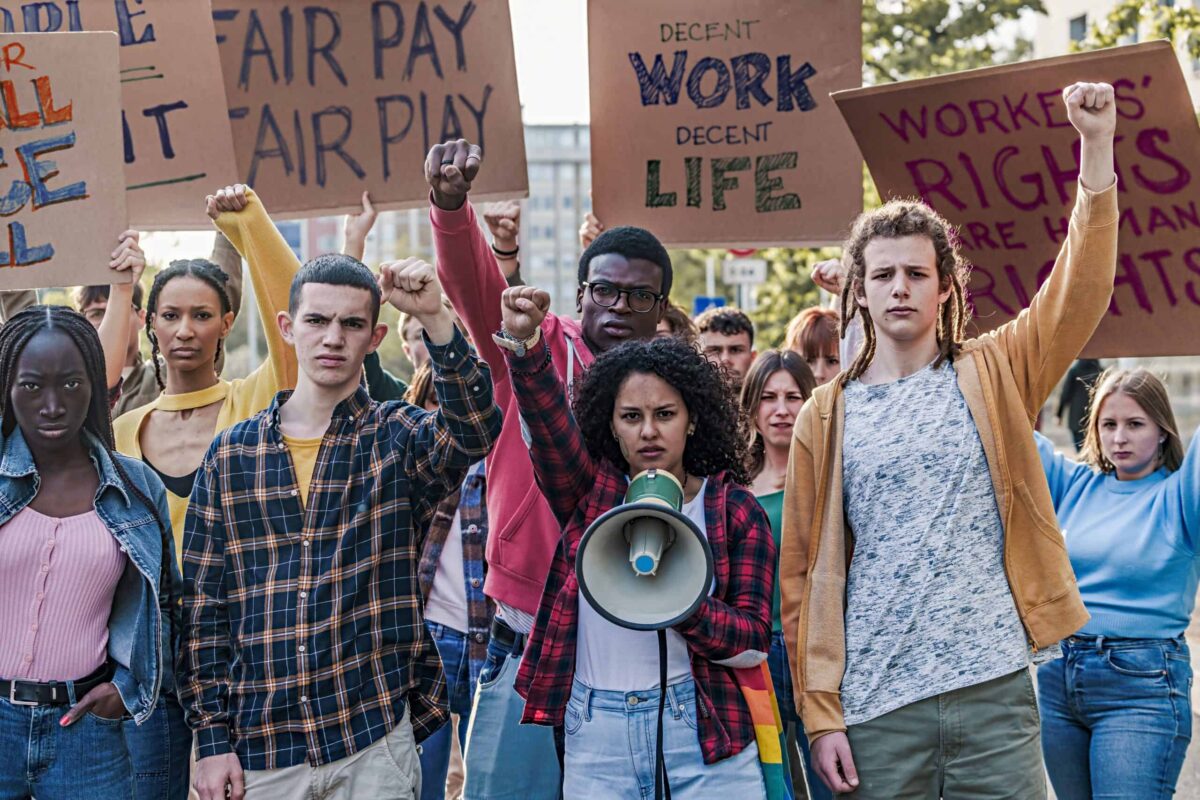
Over the decades, Virginians from multiple industries have utilized unions to progress workers' rights. (Lomb/Shutterstock)
From the Knights of Labor’s arrival in the 19th-century to a landmark 2025 casino contract, here are 12 times labor unions shaped workers’ rights in Virginia.
For nearly a century and a half, labor unions have been important engines for change for Virginia workers. They’ve brought about important shifts in how workers can protest and what rights they can claim. These now well-established principles were developed through early biracial union cooperation, mass strikes in such industries as tobacco, textiles, coal, and rail, and hard-fought legal battles. Here are 12 key moments that trace how labor unions have shaped the commonwealth’s workforce and labor laws.
1. Knights of Labor comes to Richmond
Year: 1884
In April of 1884, the Knights of Labor, a sizable and powerful labor organization in the 19th century that inducted members regardless of trade, arrived in Richmond when 11 white workers formed “The Eureka Assembly.” Although new members were slow to join, Black workers followed suit by starting assemblies of their own, even though they weren’t officially chartered because a sign-off was needed by local white leaders. Tensions between the white and Black assemblies resulted in the general master workman of the Knights, Terence Powderly, coming to town.
Powderly’s meeting with both white and Black workers resulted in the two groups coming together under one union umbrella. However, a separate-but-equal structure was enacted. The move marked the first time white and Black workers belonged to the same union in the city.
2. Baughman boycott
Year: 1886
The Baughman boycott of 1886 can be viewed as an extension of the cooperation facilitated by the Knights of Labor, given that union members worked with the Richmond Typographical Union to apply pressure to Richmond’s only non-union print shop, Baughman Brothers, to achieve unionization.
During the difficult battle, lists of blacklisted Baughman customers were published, thus limiting the shop’s business. Legal action was taken against the union, eventually resulting in the “Crump” ruling, which found that such muscular actions by a union against a business constituted a criminal conspiracy, thus curtailing union power.
3. Virginia Federation of Labor permitted Black delegates to attend state convention
Year: 1913
In June of 1913, the Virginia Federation of Labor, which served as the commonwealth’s central organizing entity of union activity, allowed Black delegates to attend the state convention in Alexandria. The delegates represented shipbuilders from Norfolk.
As a result, many well-established all-white union locals withdrew from the federation. Five years passed before the union locals rejoined the federation, at which point Black delegates had been removed.
4. Electrician strike that formed Union Electric Company
Year: 1919
The electricians in Richmond who were part of Local Union 666, which formed in 1910, went on strike in 1919 following a dispute with contractors over a proposed pay increase. Due to the contractor’s unwillingness to budge, the workers formed Union Electric Company. The timing was just right, as a fire had damaged an area newspaper’s plant and the newspaper hired the striking electricians for the repair job.
To fund the company, the workers contributed 25% of their earnings. Within a few months of its founding, the company had already done $17,000 in business. It was later bought out by one of the members, who ran it as the only sizable, organized contractor in the city until 1932. The company remained in business until the 1980s.
5. Covington Sit-Down Strike
Year: 1937
The year 1937 brought a sit-down strike to the small community of Covington when roughly 400 workers at the Industrial Rayon Corporation plant decided to make their discontent known after negotiations over pay and union recognition broke down. Actions taken by plant management poured fuel on the fire. The strike, which later devolved into violence and a legal battle, went on for four months.
It was eventually squashed with the plant ordering those on the losing end back to work. Some union leaders ended being prosecuted under an anti-lynching law for mob violence.
6. Richmond tobacco workers strike
Year: 1937
Richmond witnessed a considerable amount of unrest among tobacco workers in 1937. Perhaps most surprisingly, in May of that year, roughly 400 Black women who worked as tobacco stemmers began striking at the I.N. Vaughan plant due to dissatisfaction with wages and working conditions. The women were earning a meager $3 a week for more than 80 hours of work in brutal conditions.
Their actions were viewed as part of a broader industrial-union organizing push by the Congress of Industrial Organizations. Their bet paid off with increased wages, the implementation of a 40-hour workweek, and an opportunity for collective bargaining.
7. United Construction Workers v. Haislip Baking Co.
Year: 1955
The 1955 United Construction Workers v. Haislip Baking Co. case from Norton served as a win for labor unions because the court found that unions are not liable for damages incurred through a “wild cat” strike, meaning one that it didn’t organize or take part in.
The case originated from a conflict concerning the dismissal of two employees at Haislip Baking Company. A strike broke out, and although the United Construction Workers union advised workers to return to their jobs despite the company’s unwillingness to rehire those who were fired, they refused, and the bakery went out of business.
As a result, the company sued the union for damages, which it was awarded by a jury. However, an appeal found that although the strike violated the terms of the collective bargaining agreement, the union couldn’t be held liable because it didn’t participate in the action.
8. Teamsters Local Union No. 822 v. City of Portsmouth
Year: 1975
A Fourth Circuit Court of Appeals ruling in the mid-1970s titled Teamsters Local Union No. 822 v. City of Portsmouth established that the commonwealth’s banning of collective bargaining for public workers was, in fact, a violation of their rights under the First Amendment.
Initiated by Teamsters Local 822, which represented city employees against the City of Portsmouth, the key distinction in the ruling was that although strikes by public workers could be banned, the workers had a right to collective bargaining through unions.
9. Pittston Coal strike
Years: 1989-1990
Mine workers in Southwest Virginia, as well as in West Virginia and Kentucky, launched a coordinated strike effort from 1989 to 1990 through the United Mine Workers against Pittston Coal, the largest exporter of coal at the time, because it decided to do away with health and retirement benefits. The strike led to widespread disruption in the region.
Eventually, the miners voted to ratify a new contract that offered concessions from the company, which ended the strike. The strike is credited with helping pass the 1992 Coal Industry Retiree Health Benefit Act, which provided benefits to workers of defunct mines.
10. Roanoke rail worker strike
Year: 1991
Railroad workers in Roanoke turned out in April 1991 to support a nationwide strike by abandoning their efforts to get cargo and passengers where they needed to be on time in favor of the picket line. While the Roanoke workers only numbered in the hundreds, they were part of a 235,000-worker, 11-union effort to demand improvements to compensation and working conditions.
However, Congress and the Bush administration quickly passed legislation requiring those on strike to get back to work.
11. Danville Ikea union drive
Year: 2011
Workers at an Ikea plant in Danville raised the alarm in 2011 through the International Trade Union Confederation because of what they described as unequitable working conditions, in sharp contrast to similar plants in the furniture-maker’s native Sweden. At the time, the plant employed over 300 workers.
Ultimately, a union drive through the International Association of Machinists and Aerospace Workers prevailed at the plant in a 221 to 69 vote. The situation at the plant even garnered international attention, with significant public pressure directed against Swedwood, Ikea’s manufacturing subsidiary.
12. Casino workers secure union contract
Year: 2025
Portsmouth once again made union history last year when workers at the Rivers Casino secured a union contract by voting 95% in favor of ratifying a collective bargaining agreement. The vote established the workers as the first casino workers in the commonwealth to secure a union contract.
The workers were represented by Teamsters Local 822. Labor organizers said the contract will provide workers with a 15.95% raise and employer-paid health insurance for the duration of the contract.
5 fascinating facts about Newport News native Ella Fitzgerald
Here are five facts about Ella Fitzgerald, a Newport News native who is one of the greatest jazz singers of all time. Before she moved to New York...
This winter, learn the real story of Pocahontas
Pocahontas’s life is often shaped by the colonizers who rewrote her history. This is the real story of the Native American girl whose name meant...

8 historical (yet haunted) battlefields in Virginia
At these haunted battlefields in Virginia, bloody histories and ghostly legends come together. Nowadays, Virginia’s rolling hills and tranquil...

Songcatchers: The fascinating story of how scholars saved Appalachian music from extinction
At the turn of the 20th century, academics traveled the Appalachians to save ancient music before it was lost. Learn how the legacy of the...
5 unsung films that dramatize America’s rich labor history
By Peter Dreier, Occidental College The U.S. is in the midst of a new upsurge of union organizing. Is a Hollywood drama about angry Starbucks...
Southwest Virginia’s surprising country music history
Country music has deep roots in Southwest Virginia. Here’s what you need to know about its history. When most people think of country music, they...