Dark tourism has become increasingly popular over the years. Here are six places to visit in Virginia that are both morbid and historical.
If this is your first time hearing the term “dark tourism,” you’re not alone. This type of travel has existed as long as tourism has been around. However, it wasn’t until the late 1980s that people began searching for the right term to describe it, eventually settling on “dark tourism” by the 2010s. Essentially, the term is used to describe traveling to places typically associated with tragedy and death, but from a historical perspective. Two of the clearest and most common examples of this are the Catacombs of Paris and London’s Jack the Ripper tour. Each of these is linked to a specific moment in history that’s macabre in nature.
Virginia is, of course, a deeply historic place. Woven into the fabric of its history are sombre threads of death, loss, and grief. Each of these six locations is steeped in a sense of lore that plays a key role in what makes them so interesting to visit. From Richmond’s Belle Isle Ruins to Assassin’s End in Port Royal, these dark tourism attractions will teach you something new—and maybe even give you goosebumps in the process.
1. Belle Isle Ruins, Richmond
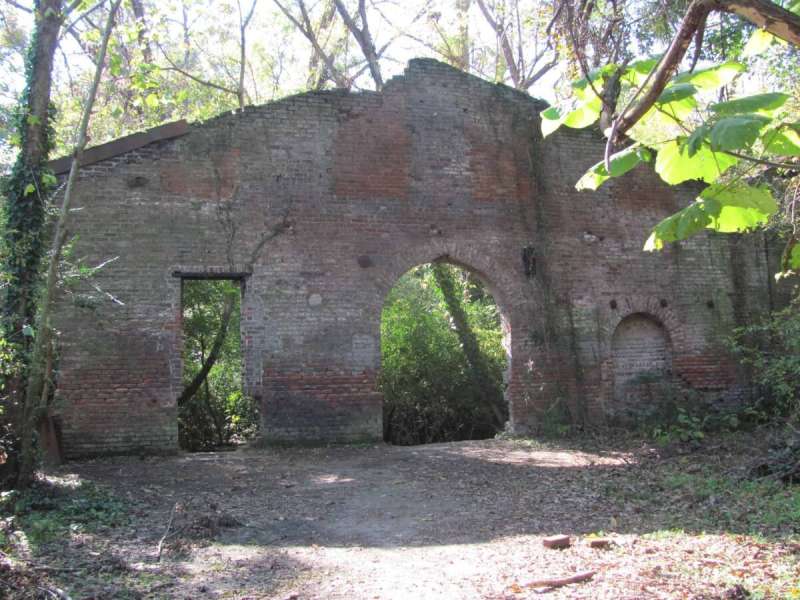
The first stop on our dark tourism tour of Virginia leans more into the historical element of this form of travel. Belle Isle has worn many faces over the centuries. Native Americans settled here first (as they did on every stretch of land within the greater United States), and it’s rumored that John Smith explored the 540-acre island at one point. A few hundred years later, Belle Isle saw the construction of a nail factory on its land that slowly fell into ruin on the eastern side of the island. You can explore the ruins during your visit.
Perhaps the most “unsettling” part of Belle Isle’s story is that it was used as a Confederate prison camp during the Civil War. Thousands of Union soldiers were held prisoner, many of whom died during their imprisonment on the banks of the James River. Atlas Obscura notes that their remains are no longer on Belle Isle, but that doesn’t mean that their ghosts don’t still linger there.
As you walk through the park and see these abandoned ruins for yourself, it’s hard to shake off the lingering feeling of being acutely aware of the passage of time, and of how it eventually takes us all along with it.
2. Evergreen Cemetery, Richmond
Before we head out of Richmond, we’re going to make a stop at the Evergreen Cemetery. Constructed in 1891, this 60-acre stretch of land was intended to serve as the final resting place for African American leaders, pioneers, and residents. The idea was to create a burial site akin to Hollywood Cemetery, where Richmond’s notable white residents were buried. Evergreen, unfortunately, has not been as well-maintained over the years. The graves, vaults, and mausoleums are overgrown, but the heart of its history remains.
Civil rights activists from Virginia and community leaders such as Reverend J. Andrew Bowler, Maggie L. Walker, A.D. Price, and John Mitchell Jr. were laid to rest in Evergreen. You can pay your respects to them, as well as the countless other Black residents who helped build and shape Richmond’s rich tapestry of existence, during your visit.
In recent years, cleanups have been intermittently conducted to help restore Evergreen Cemetery to its former glory. According to Richmond Cemeteries, the city’s Parks and Recreation Department is responsible for consulting with descendant groups and volunteers to help preserve the legacy of those resting in Evergreen, along with those in East End Cemetery.
3. African American Burial Ground for the Enslaved at Belmont
It is impossible to talk about American history without talking about its profoundly horrific involvement with slavery. The African American Burial Ground for the Enslaved at Belmont is perhaps the most important place on this list because it forces you to confront those horrors firsthand, as well as society’s longstanding efforts to erase those atrocities from existence. Like Evergreen Cemetery, Belmont’s African American Burial Ground for the Enslaved fell into decades of neglect.
The cemetery was eroded due to nearby construction. Flooding in the 1950s led the land’s owner to create a large pond on the property that was believed to have been constructed over numerous graves. It’s unclear how many enslaved people were buried in Belmont, though estimates are around 80 individuals. Pastor Michelle C. Thomas has been working tirelessly to ensure that the remaining graves of those souls—who she discovered were enslaved people from Coton and Belmont’s plantations—are properly and respectfully maintained.
In October 2015, the cemetery was reclaimed as a dedicated burial site and sacred ground. Two years later, the Loudoun Freedom Center received the 2.75 acres of land as a donation from the site’s developer. Now, the center works to preserve the area’s Black heritage by maintaining a historic site within the cemetery that’s dedicated to remembering, honoring, and studying the area’s history and the lives of enslaved people who were buried here.
To learn more, please click here.
4. The Ghost Church, Mechanicsville
Amid the rural landscape of Mechanicsville lies the skeletal remains of Polegreen Church. The historic structure has been dubbed “The Ghost Church” by locals, although this moniker is more likely due to its eerie appearance rather than any purported ghosts that may potentially haunt the area. The 18th-century structure originally served as a meeting house before it was transformed into a place of worship during the First Great Awakening.
The Presbyterian missionary Samuel Davies was a newly ordained, non-Anglican minister (the first licensed non-Anglican minister in Virginia) when he arrived at Polegreen Church to preach. In addition to becoming the first credited American hymn writer, Davies helped teach enslaved people how to read. “Lord, I Want to be a Christian in My Heart,” a slave spiritual, derives its origins from the Polegreen Church.
The structure burned to the ground in 1864 during the Civil War. The foundation of the original building was added to the National Register of Historic Places, and you can view its strange white frames and floating windows the next time you’re passing through Mechanicsville.
5. The Tombstone House, Petersburg
Petersburg’s Tombstone House is the epitome of dark tourism. In 1934, the home was constructed using marble tombstones that once marked the graves of Union soldiers at Poplar Grove Cemetery. The government had previously installed the stone graves after the original wooden ones had rotted, but cemetery maintenance fell by the wayside in the Great Depression. It was at this point that Petersburg officials decided to cut the marble headstones in half to sell a portion of each. They left the upper part of the stones bearing the soldiers’ names and other details on the gravesites, and used the lower portion for sales. In total, the endeavor earned them about $45.
Around 2,200 tombstones were cut and sold to Oswald Young, who decided to construct a home with them. The graves were used for Young’s walkway, house, and chimney, all of which are still standing to this day.
6. Assassin’s End, Port Royal
Before we wrap up our informative though grim tour of Virginia, we’re going to take one last stop to see Assassin’s End in Port Royal. After John Wilkes Booth assassinated President Abraham Lincoln on April 14, 1865, Booth fled. The Union Army pursued him, along with David Herold, who conspired with Booth to assassinate the president, over the course of 12 days. The two men chose to hide out on a Virginia farm, but the largest manhunt in US history (at that time) eventually led to a standoff in Port Royal that left Booth dead. Herold had already surrendered before the soldiers set fire to the barn where the two men had been hiding.
Booth was shot and severely wounded. He succumbed to his injuries a few hours later. The farm saw its own complicated, confusing history over the years before being torn down in 1964 during a nearby highway expansion project. Now, what remains of that fateful moment in time is merely a historical marker on the side of the road that reads: “This is Garrett Place where John Wilkes Booth, assassin of Lincoln, was cornered by Union soldiers and killed, April 26, 1865. The house stood a short distance from this point.”