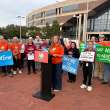
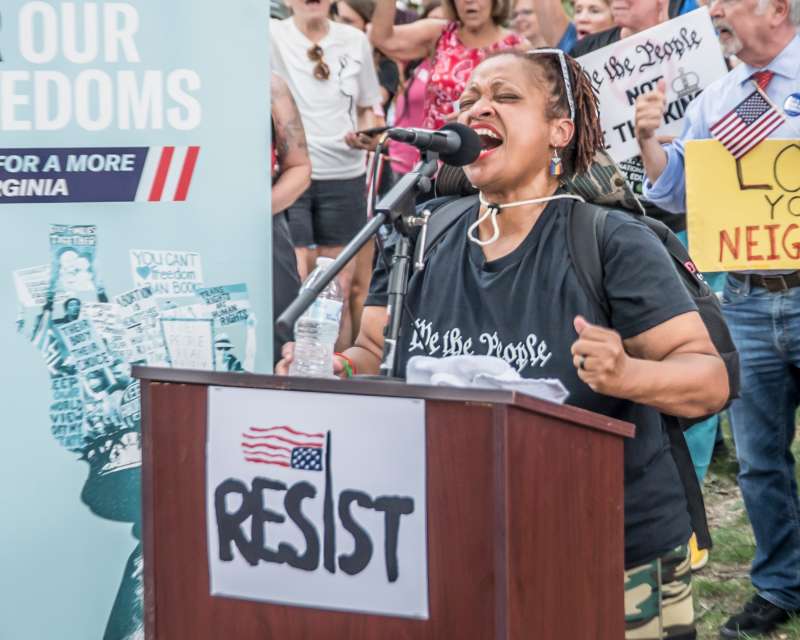
Virginia resident Nicole Subryan shared her personal story with Dogwood’s special correspondent for reproductive healthcare, Bonnie Fuller. Virginians will decide whether to enshrine protections for women’s reproductive healthcare in the state constitution when they vote in the Nov. 3 midterm elections.
Question 1 asks voters whether to amend the Virginia Constitution to protect the freedom to make decisions about prenatal care, childbirth, postpartum care, birth control, abortion, miscarriage management, and fertility care. The amendment would also protect healthcare workers and patients from being punished for those decisions. The state could still restrict abortion in the third trimester, but it could not ban one if the fetus isn’t viable or a physician determines it’s necessary to protect the patient’s life or physical or mental health. Early voting has already started.
I was using an IUD and was 41 years old. I never expected it was possible for me to get pregnant.
But one night, as I was lying on my stomach in bed, I felt this fluttering in my stomach. A quickening movement.
I’m a registered nurse, so I knew that it was important to immediately make an appointment to get it checked out by my OB-GYN. When I went, I found out that I was pregnant and already in my second trimester.
Fortunately, I was in a stable relationship with my now-husband. He had helped me raise my son, who is 26 today. We both really wanted the baby.
Then, all of a sudden, at 19 weeks pregnant, I began to bleed. A lot.
I went right to a hospital emergency room near Richmond, Virginia, where we live.I’ll never forget what happened.
A technician did a sonogram, and my baby’s heart was still beating. But as I was anxiously waiting to see the doctor who would tell me what was going on, I had a sudden urge to go to the bathroom.
When I did, the fetus passed out of me. I instantly knew what had happened and I was very upset, but I had to get right back in bed because I was still bleeding so much.
Instead of slowing down, the bleeding was picking up.
When the OB-GYN came in, she performed another sonogram because she suspected that the placenta was still attached inside me, and it turned out that that was true.
At first, the doctor tried to release the placenta by pushing on my stomach, which was very unpleasant, and I kept on bleeding. But as she was pressing on my stomach trying to push out the placenta, I began to feel dizzy and lightheaded.
My vision narrowed to tunnel vision. I told the OB-GYN that I was dizzy, and the next thing I knew, she was rushing me back to the OR to do a D&C (dilation and curettage) to empty my uterus (of all the leftover fetal material).
I don’t remember much after that until I woke up.
It was very sobering when I awoke after the D&C, and having received two units of blood in a transfusion. Being a nurse, you know the ramifications of what could have happened, and they kind of haunt you.
Not only did I lose a baby, I almost lost my life.
And I had a lot to lose. I had a son that I wanted to be on this earth for. And as a medical practitioner, I know all the things that could have gone wrong for me, especially as a Black woman.
Black maternal mortality is so high in this country.
Editor’s note: Black women die at more than three times the rate of white women who have a baby in the US. In 2024, the Black maternal mortality rate was 44.8 per 100,000 live births, versus 14.2 deaths per 100,000 for white women, according to the Centers for Disease Control and Prevention (CDC). The US has among the highest maternal mortality rates of any high-income country, according to a 2024 Commonwealth Fund analysis, which found 22.3 deaths per 100,000 live births in 2022. The CDC’s national rate has since fallen to 17.9 in 2024.
I realize today that if this had happened after Roe v. Wade was overturned and I had still been living in Georgia, where I went to college, I could have died like Amber Nicole Thurman.
Thurman died during surgery after an Atlanta-area hospital waited about 20 hours to perform a D&C, while fetal tissue left in her uterus caused a deadly infection. Hers was a totally preventable death.
My past abortion experience informs current advocacy
I actually had to have an abortion myself in Georgia when I was a sophomore at Spelman College in Atlanta. I was 19 and had a boyfriend who was a “Morehouse man” from Morehouse College across the street.
We moved in together off campus. For a while, I was on the pill for birth control, but it was hard to get to the Planned Parenthood clinic in downtown Atlanta, so we started using condoms—but not always.
You know how a guy will say, “These aren’t always so comfortable, and you can’t get pregnant, right?” I was stupid enough to go along. It was just young stupidity.
I found out that I was pregnant when I started getting this weird spotting that wasn’t normal for me. Otherwise, I felt perfectly fine. I had gained a few pounds, but then who doesn’t put on the “freshman 15” in college?
I decided to take a trip to the student health center on campus, and they did a pregnancy test. It turned out that I was already almost 14 weeks pregnant.
I knew that I would have to get an abortion. I had aspirations for my life, and at this point they did not include being a wife or mother.
It was scary to tell my boyfriend, and he was stunned and disbelieving at first. But he was very relieved when I told him that I didn’t want to be a mother.
My first step was to contact my mother’s health insurance provider, Kaiser Permanente, because I was on her plan. I needed to go to one of its abortion providers in order to get the procedure covered.
Then my boyfriend and I had to put together the money to cover the taxis to its surgical center, which was about 15 miles away, since we didn’t have a car. My boyfriend was supportive and he went with me, but once the abortion was over, our relationship didn’t last much longer.
I realize that if I had gotten pregnant today as a student at Spelman College in Georgia, I’d be a mother whether I wanted to or not, because of the state’s six-week abortion ban.
My two experiences—almost dying because of a miscarriage and needing to get an abortion as a college student—are why I’m working so hard now to get Virginia voters to the polls and to vote yes on Question 1, the Right to Reproductive Freedom Amendment, on the midterm ballot.
Getting out the vote on Virginia’s abortion amendment
I like to call myself an all-purpose activist now. I went by myself to Washington, DC, to join the first Women’s March after Donald Trump was sworn in in January 2017 and then organized two busloads of protesters for the second Women’s March there.
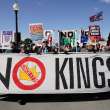
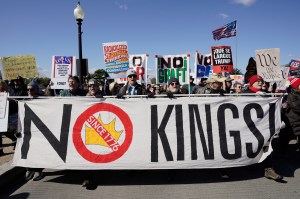
I’ve spoken at the three local No Kings rallies in Richmond, Virginia, and now I’m the first vice chair of the Chesterfield County Democratic Committee in charge of elections and operations.
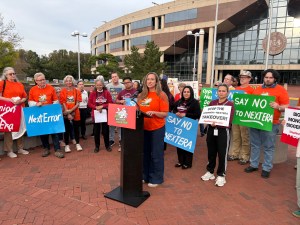
Early voting has already started here. We have poll greeter volunteers stationed, where they are allowed (40 feet away), outside the early voting polling stations. They have information about what’s on the ballot, including the reproductive freedom amendment, which is near and dear to my heart.
We’ve designed and are printing amendment signs for people’s yards, and we’ve been “tabling” at local festivals, where we set up tents and tables and talk to voters about issues, candidates and the three amendments on the ballot.
Editor’s note: Besides the amendment to add reproductive rights to the Virginia Constitution this November, voters will see a ballot amendment to repeal the same-sex marriage ban from the constitution, and an amendment restoring voting rights to Virginians who have completed their prison sentences.
We are also encouraging everybody to vote early in this midterm election because of the threat of Trump. He asked people at his midterm convention in Dallas to raise their hands and pledge to cheat.
So, on our committee, we are encouraging everybody to vote early and, if you have a ballot mailed to you, to walk it into one of the early voting locations and drop it off.
Why abortion restrictions put women at risk
I have a particular affinity for Roe v. Wade. I was born the year that Roe v. Wade was born. In fact, I was born Jan. 7, 1973, and Roe came into being on Jan. 22, 1973.
I was devastated when the Supreme Court announced the Dobbs decision.
My first feeling was, horribly, thankfulness that I had a son because if I had had a daughter, she would have had fewer rights than I did.
But I wasn’t shocked because I could see the makeup of the court, and I could see how states had been chipping away at Roe for years. I knew that there was no way that they weren’t going to outlaw abortion, even though they tried to “pretty it up” by saying, “Oh no, we’re just tossing it back to the states.”
I knew how bad this would be medically for women since I’m a registered nurse.
After my abortion, I actually dropped out of college, but I began working in a medical lab, and I just loved doing all the blood tests and other lab work and running all the machines.
I ended up enrolling in Prince George’s Community College to take all the courses that I would need to apply to nursing school. I had top grades in the program and graduated.
I had a serious boyfriend at the time and got pregnant with my son. But I made a promise to myself when I had him. I told myself, “Nicole, before this baby turns 1, you’re going to be in somebody’s nursing school.” And that’s precisely what I did.
I got in to Johns Hopkins School of Nursing, and I got a full scholarship. But when I went to the Johns Hopkins financial aid office, I was told, “Oh, you’re a single mother. We’ve never had a single mother get through this program.”
I was like, “I’m going to be the first.” I was a part of a small group of African American women who were determined to make it through that program. And I did.
I can tell you now, after 23 years as a registered nurse specializing in critical care in cardiology, that every medical situation is unique. I’m not in favor of any restrictions whatsoever on abortion or any women’s reproductive healthcare. You cannot write legislation that will cover every eventuality.
I hate that we even have to have an amendment giving women a right to their own bodies. We don’t have to do that for men.
Women shouldn’t be bleeding out in hospital parking lots before they can get a termination. And Black maternal health is of particular importance to me. We have already drawn the short end of the stick on that. You throw in anything like the Dobbs decision to make things worse for my community, then I have an obligation to speak out.
READ MORE: Virginia ballot questions: 3 constitutional amendments voters will decide this fall