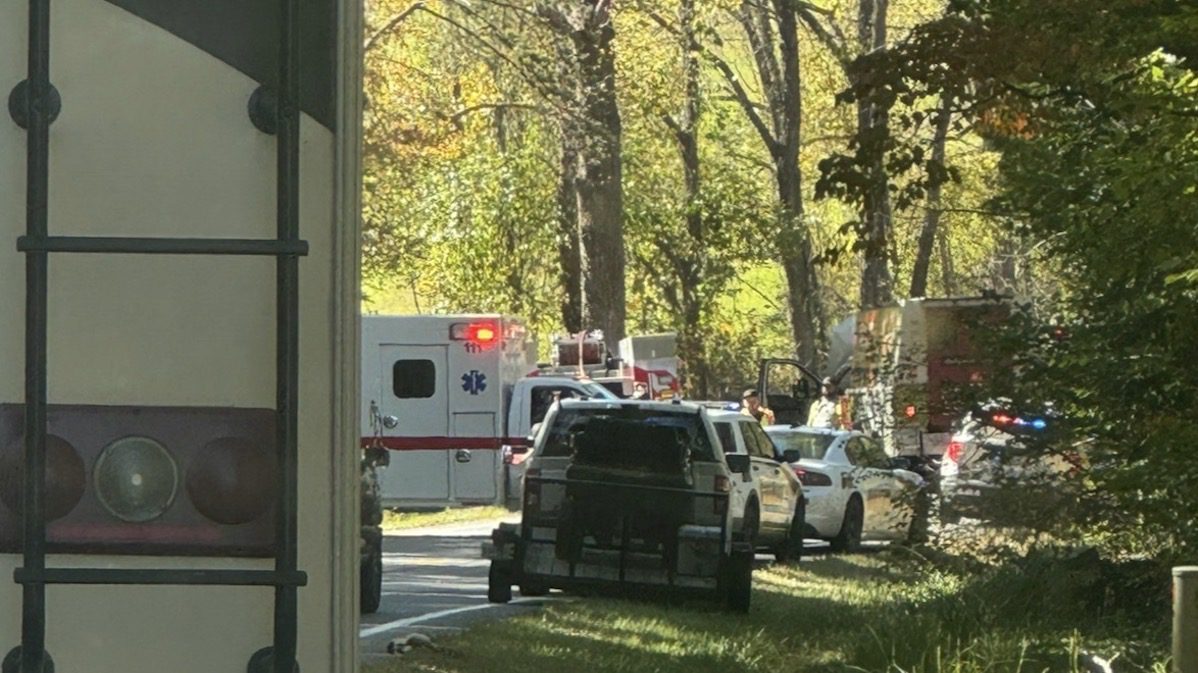
A head-on collision occurred on Oct. 17, 2025, in Patrick County. (Amie Knowles/Dogwood)
Sometimes, it’s not what you did that haunts you—it’s what you didn’t do. That’s why the bystander effect often hits hard after the sirens fade.
We got such a late start on our weekend trip to Tennessee. My husband was getting over an illness, it took a hot minute to do all the necessary chores that morning, my seven-year-old was constantly asking if I’d packed his Switch 2, and anything that could grate on my nerves was doing just that. You’ve seen the chaotic scene before Kevin’s family left on their trip in Home Alone? This was worse.
Keeping an eye on the arrival time on the GPS, we opted to swing by a drive thru for lunch and head up the mountain toward Lover’s Leap in Patrick County. Maybe we’d have time to swing by some of the shops at Meadows of Dan or have a quick jaunt around Mabry Mill (it’s always prettiest in the fall).
Just as we started ascending the mountain, we hit a traffic jam—and our GPS blocked off US Route 58.
Now, there’s been plenty of road work going on in that area (don’t get me started on the destruction of what I consider to be the prettiest little drive in all of Virginia). So we weren’t too surprised to see cars backed up. After a couple of minutes, we turned around in a driveway and rerouted, taking the road toward Ararat.
It’s one we’re vaguely familiar with after a handful of daytrips to Mount Airy. Man, was it ever beautiful. The leaves were changing, the streams were babbling, and right as we got around Claudville, we came to a dead stop. We were about four or five vehicles back, and it looked like some type of work truck was stopped sideways on the road, blocking both lanes.
There was absolutely no cell signal. A car ahead of us made a U-turn, using the ditch and the narrow two-lane road. My first thought? This is some kind of set-up; where are our exit points? It took longer than it should have to register that there’d been an accident.
One man, who we dubbed Red Shirt Guy, had pulled his pickup truck and trailer to the side of the road right behind the work truck. He was out walking around and, at least from my view several vehicles back, didn’t appear to be panicked. The door of the work truck was open, and it seemed as if the driver had maybe taken a curve too fast or hit a nearby dead racoon and then hit a tree.
My husband and I took that opportunity to tell our child that if you can ever avoid it, don’t hit a tree—not even a small one. I took out my phone to zoom in to see better. The reporter in me snapped a couple photographs, talked again about how much it sucked that the local hospital—which closed its doors in 2017—was no longer right up the road, and thought about what type of article that would make.
Still, no indication of panic or urgency. Red Shirt Guy wasn’t flagging down other drivers to come and help or behaving in a way that tipped me off that maybe there was something I could do to be useful. So I sat. I waited.
That’s part of the bystander effect—a scenario when, as Psychology Today puts it, “the presence of others discourages an individual from intervening in an emergency situation.”
In the article, social psychologists Bibb Latané and John Darley explained the bystander effect this way: “The perceived diffusion of responsibility means that the more onlookers there are, the less personal responsibility individuals will feel to take action. Social influence means that individuals monitor the behavior of those around them to determine how to act.”
While watching Red Shirt Guy walk around, I spouted off stories about how these were always the hardest news articles to write when I was out on the road in my early days as a journalist. That being right there after someone’s scariest moment—and then asking questions about it, taking pictures of it—was a scenario I never took lightly… or just as “part of the job.” I even told the story of holding up a truck tipped against a ditch when I was pregnant with Colton, helping to keep it steady as the driver emerged from the wreckage.
But, for whatever reason, this time, I didn’t get out of the car.
As best I can tell from picture timestamps on my phone, it took somewhere between 10 and 20 minutes for the full gamut of emergency responders to arrive: A firetruck, an ambulance, two local police cars, one state trooper, and another emergency vehicle, as best as I could tell. I saw what appeared to be a blue object being loaded into the back of the ambulance; it took 20 minutes for that emergency vehicle to leave the scene—with lights, but no sirens.
An hour after we stopped, we were moving again. As we passed by the accident, it became clear that it wasn’t a one-vehicle ordeal and a tree. It was a head-on collision—and the Toyota Tacoma on the other side (that we couldn’t see from where we were)—was horrifically crushed in the front and on the driver’s side. Both front tires were bent outward, and the whole area where the hood used to be looked like a crumpled soda can.
“Good Lord,” I muttered.
The rest of the ride to Tennessee wasn’t like it usually is. I don’t remember much of it, other than being increasingly okay about it taking longer than it was “supposed” to—knowing that if we would’ve been a few minutes faster on either route we’d taken, that could’ve been us. And that for other folks, it was them.
When we finally got to the hotel around sunset, we put on our pajamas and had a pizza delivered to the room. I wondered about the people in the accident, and what they’d likely give to have a pizza with their loved ones that night. Were they alright? I scrolled on my phone for hours after our son fell asleep, looking for any information about the wreck. I only saw a few posts on social media, but none with any answers about the people involved. I’ve looked several times since.
Being in journalism, I knew I could call a handful of sources and find out what happened within minutes—but I didn’t. Over a week later, I still haven’t. There are a few reasons why. First, of course, there’s the principle of the Schrödinger’s cat experiment: If I don’t know for certain how the people are, then there exists an equal chance in my mind that they’re fine or not fine. Not knowing helps partially downplay some of the guilt I’m feeling for not acting. Not that that mindset makes things right—just that when I set out to write this piece, I promised myself I wouldn’t mince the truth, even if it was hard to say.
And on that same front, if I’m being honest? I haven’t called because I’m disappointed in myself; no, worse—I’m ashamed. I can look back and spout off all the reasons I didn’t get out of my car to help. To most folks, I could probably even justify it. I didn’t know. I had my child with me. I was scared. I assumed someone closer, like Red Shirt Guy, had more control over the scene than I did. I didn’t want to be nosey. I didn’t want to get in the way.
But then I wonder, how does that make me any different from the people on the light rail train in Charlotte, North Carolina, who didn’t move to help Iryna Zarutska when she was stabbed to death in August? At the time, I sure said I’d have done something if I was on that train—and then when an opportunity to help in a time of crisis happened on a winding mountain road in my own state not even two months later, I sat. I snapped photos. I looked, inconvenienced, as the time of arrival to our destination continued to get later on my GPS.
“I feel so disturbed that my first instinct was to take a picture,” I told my husband later that night, unable to fall asleep. “To think about writing an article. Why didn’t I get out to help? Years ago, I got out to help. Every time. I’d sit with them, listen to them, talk with them. But now, I didn’t even think to get out of the car and check on them before the ambulance arrived? What happened to my humanity?”
He took my hand. His blue eyes looked deeply into my greens. He didn’t try to make it better, didn’t tell me it was all okay. All he said was, “Then maybe that’s what you write about.”
And so I am.
Because the truth is, I failed that day. I failed the part of me that once ran toward sirens instead of waiting for them to pass. The part that steadied shaking hands, that held strangers and promised it would be alright. Somewhere along the way, I let the noise of the world—the deadlines, the distractions, the fear—dull that instinct.
And maybe that’s the hardest thing to admit.
I keep thinking about those mountains. The beautiful colors of fall, the crisp chill in the air, and the stillness of the cars lined up on that narrow stretch of road. Somewhere in that silence, someone’s whole world changed—and I just sat there.
I can’t undo it. I can’t unsee it. But next time, I can choose to move. God, I hope I choose to move. If the people involved are reading this—or their loved ones are—please know that I’m so sorry and that if I could go back and change it, I would. And if anyone else finds themselves in that same terrible stillness someday, I hope they do what I didn’t.
I hope they get out of the car.
RELATED: Rural Virginia families like mine are crossing state lines for pediatric health care
Support Our Cause
Thank you for taking the time to read our work. Before you go, we hope you'll consider supporting our values-driven journalism, which has always strived to make clear what's really at stake for Virginians and our future.
Since day one, our goal here at Dogwood has always been to empower people across the commonwealth with fact-based news and information. We believe that when people are armed with knowledge about what's happening in their local, state, and federal governments—including who is working on their behalf and who is actively trying to block efforts aimed at improving the daily lives of Virginia families—they will be inspired to become civically engaged.

I’m a Virginia mom who homeschools; here’s what it really looks like
I tried to homeschool like the Instagram reels—then realized it’s okay to throw out the plan. If you’re hoping for a “this is the perfect way to...

What to do if you forgot someone’s Christmas gift
So busy decking the halls that you accidentally left someone off your Christmas list? I’m here to help in a holly jolly haste. I’m the type that...
What a hand-colored Hot Wheel—and rural Virginia roots—taught me about true Christmas giving
I used to think the perfect Christmas presents needed to be pricey—until a tiny Hot Wheel showed me that meaning has nothing to do with money. We’re...
Hunger doesn’t take weekends off: How to help Virginians facing food insecurity
Many Virginia families depend on school meals to keep their kids fed during the week—but hunger doesn’t pause when classes end. Here’s how you can...

Yes, you can change your Thanksgiving tradition
Thanksgiving has always started in our kitchen long before the sun came up. But this year, we’re savoring the holiday in a slower, simpler way,...

10 Virginia warming centers open now—and how you can make a difference
Warming centers across the commonwealth rely on volunteers, donations, and community awareness. Here’s how you can help. While most of us move...