
Unique state law will last through April 30
HALIFAX – Lighting up the indoor fireplace? Striking a match for a candle? That’s perfectly law abiding. Starting next week, not all fires in Virginia will have the same legal status, as the 4 p.m. law takes effect.
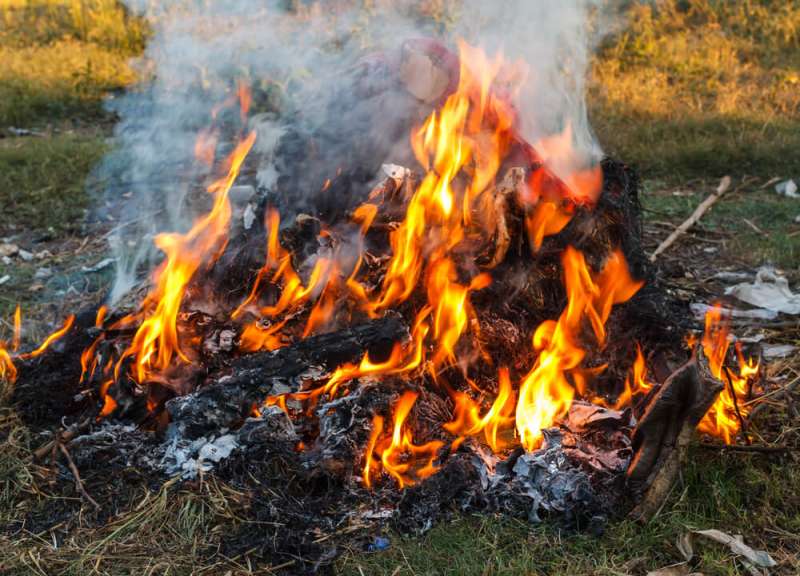
Beginning Monday and lasting through April 30, outdoor fires in Virginia are illegal before 4 p.m. Folks also cannot set new fires or add fuel to existing flames after midnight. That’s because of an annual burn ban.
The law applies to campfires, warming fires, brush piles, leaves, household trash, stumps, fields of broomstraw and brush or anything capable of spreading fire.
The Reason For The Law
Forester J. Miller Adams with the Virginia Department of Forestry explained that historically, the upcoming spring season produces a heightened risk of fires.
“Traditionally, we have found that fires that escape this time of the year are often harder to control,” Adams said. “Typically our weather patterns this time of the year have the potential to be somewhat windy. Our humidities seem to dip after lunch, 2 o’clock in the afternoon. Humidities have the potential to get really low this time of year. And then the other thing is that the leaves haven’t come out on deciduous tress, our hardwood trees yet. So all of the leaves that resulted from falling off of those trees are laying there, pretty much in direct sunlight. All of those things put together makes for a time of the year where fire suppression and the potential for escaped fires kind of is maximized.”
As the day draws to an end, the weather conditions make the potential spread of a fire less likely.
“At 4 o’clock, historically what we see is humidities are stating to go back up, and as we approach sunset, generally if we have winds during the day, at 4 o’clock, they’re beginning to trail off for the night,” Adams said. “That doesn’t necessarily mean that always happens, but typically the fire conditions are much better 4 o’clock or after than they are prior to that time.”
JOIN THE CONVERSATION: Sign Up For Dogwood’s Newsletter
No Side Stepping
The ban applies if the fire is in or within 300 feet of woodland, brushland or a field containing dry grass or other flammable material. That sometimes causes confusion.
Adams helped clarify common misunderstandings and misinterpretations surrounding the particulars of the ban.
“The way the law reads, if there is nothing that is capable of carrying the fire to a wooded area, then it’s alright before 4 p.m. But that would be any kind of grass,” Adams said. “You’d pretty much have to have 300 feet of bare dirt to meet that requirement. And 360-degrees is a pretty unusual event to have.”
Also, just because a person owns the piece of property they’d like to start a fire on doesn’t mean the law supersedes them. Their negligence could result in a costly mistake.
“There is the potential for a fine. Each Code section of the law has kind of the maximum they can be charged. It can become pretty substantial,” Adams said. “We don’t prefer to issue summonses. But it is a very useful tool to deter people from burning during these timeframes.”
The law allows up to a $500 penalty for going against the burn ban.
Additional Consequences
The $500 fine could be the first of several costs the guilty party incurs. An individuals’s negligence could also result in court costs and fire suppression costs if the fire escapes.
“If the fire spreads to other people’s property – be it their home or a building or something that was somebody else’s – the other tool or instrument in the state of Virginia is where our Code sections read that if you are responsible for a fire, or found responsible for the fire, then you are liable for the efforts, the cost that it takes to put that fire out,” Adams said. “That can, in certain situations, depending on how big the fire gets and how many resources it takes to extinguish the fire, can be much higher than any fine that could be imposed.”
Taking 4 P.M. Law Seriously
In effect for the next couple of months, Adams urged Virginias to take the fire precautions seriously.
“When we look at the things, the whole picture, it’s just a time that we need to take extra cautions. Obviously people’s safety, the public’s safety, the safety of those of us at volunteer fire departments, our wild land firefighters. There have been events where there have been fatalities and injuries. So first and foremost is the safety of the public. That’s the most critical,” Adams said. “And then second is property belongings, in addition to other landowners, as well as the person who may have an escaped fire. It’s never a good situation when property’s lost or lives are lost or people are hurt. That’s why we just urge that we would much rather work to prevent fires than to have to deal with them after a fire’s going. Prevention is always key to preventing unnecessary situations.”
Amie Knowles reports for Dogwood. You can reach her at amie@couriernewsroom.com