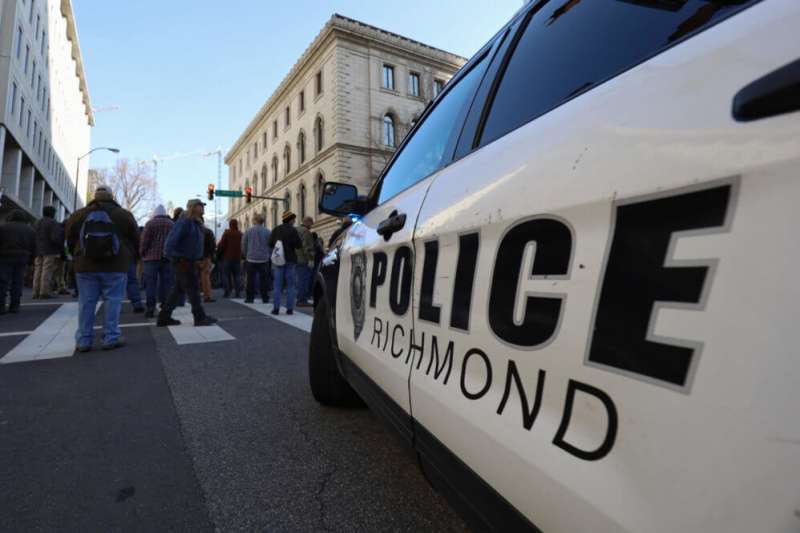
City council argues police raises are needed to keep officers from leaving. Residents meanwhile want the money spent elsewhere.
RICHMOND – The Richmond City Council’s proposed budget amendments triggered alarms throughout the city this week. People raised concerns about the plans to divest from care infrastructure, including affordable housing. Others grew upset over proposed cuts to dozens of outside agencies, asking how the council could do that while committing to increase pay for police officers.
On Wednesday, as council members gathered for another budget discussion, they offered some explanations, made some changes and overall, talked about plenty of cuts.
A Focus on Police Funding
One goal of Wednesday’s meeting was to find money to raise salaries for police and fire department employees.
Under Mayor Levar Stoney’s plan, police officers and firefighters would receive $3 million in raises. The reason, Stoney said in his budget proposal, is to “continue to address retention within our police and fire departments while making the city more competitive with surrounding public safety organizations.”
Basically, the mayor believes without this extra money, officers will leave the department. The majority of the council agreed, adding this $3 million to the budget on April 26. Most said they had no choice.
“We’ve lost 74 police officers [this year]. And if we don’t do this for them, I don’t think they’re going to stay to July of next year. These men and women that sacrifice their lives every day for us, we’ve got to show them that we care. And that we don’t want to lose any more police officers,” said council member Reva Trammell.
Advocates in Richmond have a different concern. They argue that by funding raises for Richmond police, council members encourage officers to continue brutalizing Black people and people protesting for Black liberation.
“To see the budget strengthened after the violence that we witnessed in the street last year, it really says whose safety is being prioritized by city leadership,” local activist Naomi Isaac said. “This increase to their pay is basically serving as a promise to them that the police will never be defunded.”
So What Do Police Want?
So what exactly do the police want? To be clear, that $3 million for raises represents step one. It’s part of a two year commitment by the council to raise the police department’s budget by $12 million. And that $12 million figure could go higher.
Police and fire department officials told council members they’ll likely come back asking for more.
“[Police and fire] told us there were other costs that were not in this plan, that they had not had an opportunity to fully vet yet. So we should expect that [ number] to be higher,” said Newbille.
Not only that, but according to city administration, despite it being part of the mayor’s budget, no one has actually vetted the request for $3 million in raises. That means as of yet, no independent group can say if it’s actually needed.
“That $3 million estimate is based on the study from the associations that have brought it to us. It has not been vetted, reviewed, or otherwise by HR or finance, budget staff,” said Lincoln Saunders, Stoney’s chief of staff.
Council members also made commitments to spend $100,000 next year on a pay study of their police department. That pay study will likely increase the amount of money the department requests funding for, according to Saunders.
Why Are We Cutting Social Services?
But if you need to increase funding for one project, that means either tax increases or cuts in other places. The council decided to find cuts, although residents question their specific choices.
Council member Michael Jones, for example, offered multiple budget cuts. They included trimming foster care, child day care, Child Protective Services, emergency communication and animal control.
That didn’t go over well.
“Your 10 proposed austerity amendments that crusade to defund our Department of Social Services for foster care, day care, and adult & child protective services in excess of $700,000.00 are an abomination,” said Richmond resident Jen Black. Writing in a letter to the council, Black urged the other members to “wake up and prevent further harm to our city’s vulnerable.”
Other members of the community echoed Black’s criticism. Residents shared more than 100 letters with Dogwood. Some criticized Jones. Others took aim at Councilwoman Ellen Robertson,
Robertson’s plan cuts funding for community development block grants by $2.87 million, while eliminating money for Homeward. Homeward is the safety net shelter for houseless people currently operating in Richmond.
Members of the community raised objections in particular against Robertson’s proposal to eliminate funding for the city’s Tax Relief for the Elderly and Disabled program. This helps elderly people and people with disabilities prepare their real estate taxes.
“We are embarrassed to see you propose such an insidious threat to our elderly and people with disabilities,” wrote Richmond resident Alexander Gorman. “To cut $4 million in relief in a time when these groups need care and support more than ever is not only negligible, but hypocritical.”
A Shift in Plans to Fund Police Raises
Affordable housing hadn’t always been on the chopping block for this budget. In fact, originally the council planned to invest between $1.7 million and $4 million. But that changed Wednesday, after hearing from financial analyst William Echelberger. He advised them to forget any budget increases for those outlets, recommending to wait for the city’s allotment of the American Rescue Plan (ARP) funds.
“The monies from the American Rescue Plan Act can be used for these purposes,” Echelberger told the council.
There’s just one problem. Tramell pointed out Richmond does not yet have their share of the ARP money.
“We don’t know how we’re going to spend it, we don’t know what we’re going to get,” said Trammell.
Trammell did not, however, fight the rest of the council when they voted to follow Echelberger’s advice. Instead, the council plans to use money from the ARP Act to provide housing resources across the city.
According to the National Association of Counties, states can not use the money that the ARP Act allocates to them to either directly or indirectly offset a reduction in the net tax revenue. That means governments can’t use that money to support programs they would normally finance.
Instead, this funding is meant to help mitigate the COVID-19 public health emergency.
These responses include making investments in water, sewer, or broadband infrastructure. That money can also go towards providing government workers who perform essential work with raises or grants.
Nowhere in the association’s guidelines on the Act does it say that local governments can use the money on affordable housing costs.
A Short Term Solution to A Long Term Problem
There’s a reason why the Biden administration doesn’t want localities to fund established projects like housing assistance programs with the ARP. That’s because funding through the Act both has limits and is temporary.
“Depending on short-term funding for a long-term issue just seems like placation. Even though we know that they might not even follow through on their promises,” said Naomi Isaac. “If you take short-term funding to support housing in Richmond, then where does that leave people in years to come?”
Isaac is a leader in Richmond’s movement for Black liberation. They’re also co-host of Race Capitol, a podcast about uncovering the racial narratives within the capital city.
Isaac draws a direct connection between the council’s willingness to delay housing resources and their support of police.
“Those who are unhoused are more likely to become targets of police violence. Those who are unfed are likely to become targets of police violence. And so I think that the divestment of community sustaining programs is really a legacy that the legislative leadership in Richmond has always had. It’s a continuation of the slavocracy that has always existed in Richmond. And it really proves, with this divestment, that they are not interested in truly solving the issues that are facing our communities now,” Isaac said.
Mental Health Services… for Police
While the proposed budget would make cuts to things like foster care, emergency communication and Child Protective Services, it would fund mental health services for police officers.
Stoney’s budget proposal allocates $30,000 in funding to address “officer mental health and trauma incurred on-duty.”
That makes local activists reflect on last summer’s protests. The same police officers who attacked them will be offered free mental health resources to address how they feel about those actions. Meanwhile, activists see nothing in the proposed budget that would help their situation.
“Black folks in the city are suffering severely when it comes to mental health. To see that the folks that are oppressing them and causing this pain get the funding to take care of their mental health, just again really shows where the city’s priorities lie,” said Isaac. “With incarceration and policing rather than… addressing the issues of violence in the city. Because then they would just be giving direct payments to the victims of police violence. Orlando Carter Jr., who was shot by the police, where’s his funding to receive money for trauma? Where’s the funding for the family of Marcus-David Peters for their trauma?”
RELATED: Police Testimony Raises More Questions in Orlando Carter Case
What’s Next
None of the members of Richmond’s City Council responded to our requests for an interview for this story. Mayor Levar Stoney also did not respond in time for publication.
Richmond’s 2021-2022 budget is still under consideration by the city council. If you want to tell the city council and the mayor what you think about their proposed budget, you can! Find the contact information of your City Council representative here. To contact Mayor Stoney, you can email him at RVAmayor@richmondgov.com.