The demonstrators also took issue with Spanberger’s support of a massive state tax break for data centers.
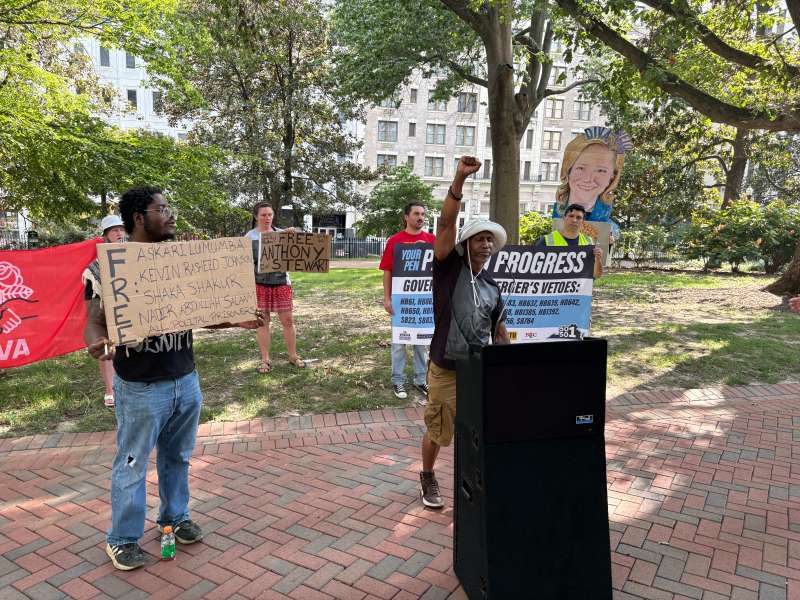
A small group gathered in Richmond on Wednesday to protest Gov. Abigail Spanberger’s vetoes of legislation related to collective bargaining and criminal justice reform, as well as her support for a massive tax break for data centers.
The demonstration was organized by the group 50501 Virginia and was billed as a way to put pressure on Spanberger, a Democrat, to use her remaining three years in office to advance progressive priorities.
The rally was more muted than a large march held in May in protest of Spanberger’s veto of legislation expanding public-sector collective bargaining rights. Wednesday’s wilting 90-degree heat likely played a factor in keeping people home. But that didn’t stop a series of speakers from criticizing Spanberger for blocking bills they expected her to sign after she got elected last year.
“We want her to know that centrism and being a moderate in this day and age of politics is not going to be acceptable anymore,” said Antoni Szachowicz, an organizer with 50501 Virginia.
“The right has learned a long time ago that playing to [the] center doesn’t work, and they went all in on MAGA, and what we need is for the Democrats to learn that lesson as well. Start actually working for progressive policies and moving forward to working for the people and not corporations.”
The governor’s office did not respond to a request for comment.
Collective bargaining
Te’Shaun Cleckley, a Virginia firefighter and member of the Coalition of Black Trade Unionists, said Spanberger’s veto of legislation to expand public-sector collective bargaining rights was a “spit in the face of the labor movement.”
“Drawing on the wisdom of Dr. King, he said, ‘The labor movement was the principal force that transformed misery and despair into hope and progress,’” Cleckley said. “And we are here today because Abigail Spanberger’s pen stopped that progress.”
In March, the General Assembly, which is controlled by Democrats, passed legislation that would have lifted the ban on collective bargaining for state employees and allowed workers in any locality to engage in collective bargaining if they wanted. Currently, localities have to pass local measures for their employees to engage in collective bargaining, and it’s up to localities how they want to write those ordinances.
Spanberger wanted to change the legislation in a way that labor unions said gutted the bill. The General Assembly rejected Spanberger’s changes in April and sent her back the version of the bill it had passed.
As with her Republican predecessor, Spanberger vetoed the collective bargaining bill. The move sparked strong reactions from state and national unions, though the once-heated rhetoric has cooled in recent weeks as attention turned to passing the state budget, which included some pro-labor provisions added by Spanberger. Those provisions were funding for firefighter cancer screenings and a change that would bump up home care workers’ pay.
But Cleckley’s comments in Richmond on Wednesday show there is still anger over Spanberger’s veto and a desire to see her expand public-sector collective bargaining rights.
“Strengthening collective bargaining is one of the most powerful policy levers states have available to confront the primary economic challenges affecting all workers today, which is an affordability crisis,” Cleckley said.
Criminal justice
Hassan Shabazz, executive director of Prisoners’ Rights Clinic, said he was distraught over Spanberger’s veto of legislation that would have added legal protections for people with a neurocognitive disorder or intellectual disability if they are prosecuted for certain crimes.
Shabazz wore a shirt bearing the image of Anthony “Tony” Stewart, who has cognitive limitations and is serving time for a nonviolent drug offense in a Virginia state prison.
“ The people must stand up, and we must stand up for those who cannot stand up for themselves,” Shabazz said
Shabazz criticized Spanberger for vetoing a bill that would have blocked out-of-state transfers to Red Onion State Prison, which drew national attention after inmates there burned themselves.
”No one in this system right now and no one coming into this system deserves to be sent to Red Onion,” Shabazz said.
Shabazz also criticized Spanberger for vetoing a criminal justice reform bill that would have prevented plea deals involving people waiving their Fourth Amendment rights against unreasonable searches.
Shabazz said such deals are “a racist construct” that disproportionately impact people of color.
Data centers
Community activist Gray Montrose questioned Spanberger’s support for keeping in place a state tax break that saves data center companies more than $1 billion a year.
The Virginia Senate had wanted to end that tax break, but ultimately got on board with a new tax on data center energy consumption supported by Spanberger.
Montrose said the money data centers save on the state tax break could be used to help the state expand collective bargaining, negotiate lower drug prices, or implement a new paid family and medical leave program faster.
“These are the sorts of things that we were promised about a Democratic trifecta,” Montrose said. “We donated, we worked, we believed those promises that said, ‘Stuff will get done in Virginia if we elect a Democratic trifecta.’”