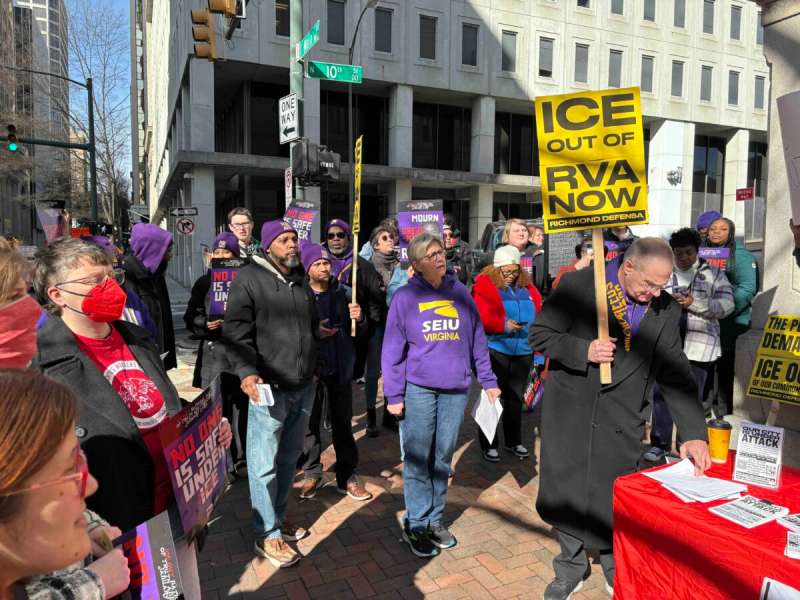
A state senator has filed three bills aimed at putting constraints on how local law enforcement can enter into agreements with ICE, preventing ICE agents from wearing masks, and making people feel safer about visiting courthouses.
As pressure mounts on Republicans to change course on their draconian immigration policy, Democratic state lawmakers are looking at how they can protect Virginians from the hostile crackdown on immigrants and its deadly consequences.
Virginia state Senator Saddam Azlan Salim (D-Merrifield) has proposed three bills to, as his office put it, “end ICE abuses” in Virginia.
Salim said he has worked for months on these bills based on his belief that immigration enforcement under the Trump administration was going to get worse. The horrific killing of Alex Pretti in Minneapolis on Saturday by federal agents proved those fears to be true and only added to the sense that state lawmakers needed to try to find a way to do something.
“We don’t want it to go from Minnesota to other states,” Salim said in an interview on Monday. “We don’t want it to become a pattern.”
The first bill, SB351, aims to prevent ICE agents from being able to arrest people in and around courthouses. Last year, there were a number of incidents of ICE agents making arrests at local courthouses in Virginia, which critics say violated peoples’ civil rights and had a chilling effect on people being willing to call on law enforcement or show up to court.
“If you are going into a courthouse or you’re coming out of it, you should be able to feel safe in the place where you’re actually going to go pay for a fine or be heard by a judge,” Salim said.
The second bill, SB352, would prevent ICE agents from wearing facemasks, a practice that has been criticized as a way for federal agents to hide their identities and avoid public scrutiny.
Salim told Dogwood that no local, state, or federal law enforcement agents should have masks on unless it’s for medical reasons or they have previously identified themselves, “so that we are no longer having a secret police that’s going around and essentially terrorizing people.”
Salim’s third bill, SB783, aims to create conditions that have to be met for state and local law enforcement officers to perform the functions of an immigration officer. The bill’s goal is to put constraints on the current agreements between ICE and state and local law enforcement agencies known as 287(g) agreements.
The bill prohibits schools and health care providers from sharing immigration information with ICE, unless they’re presented with a judicially authorized warrant. The bill also aims to limit how state and local dollars get used as part of the agreements, Salim said.
Salim acknowledged that creating state laws related to federal immigration enforcement will be challenging but this new era calls for a new approach.
“It looks like the state government is going to be taking on more than they’re anticipated to take on,” Salim said.
Bad incentives for local law enforcement
A new report from the Legal Aid Justice Center (LAJC) offers an initial portrait of the ways in which ICE is operating across Virginia.
Four state agencies have 287(g) agreements under which ICE can use their employees to act as federal immigration officers, according to the report. The state agencies are the Virginia State Police; Virginia Department of Corrections; Virginia Department of Fish and Wildlife; and the Virginia Department of Marine Resources.
There are 32 total 287(g) agreements that exist in the state, including four jails and 23 local sheriffs, according to the LAJC report. These agreements are all problematic, especially their latest iteration under the second Trump administration which, “turns your neighborhood police officer or state trooper into an ICE agent,” the LAJC report said.
The other concerning aspect of immigration policy today is the way the Trump administration has incentivized collaboration with its crackdown, Alex Kornya, LAJC’s litigation director, said in an interview.
LAJC learned through Freedom of Information Act Requests that many localities with ICE agreements have signed onto a second agreement that dictates the terms of how people and agencies get reimbursed for their work under the agreement. These localities will be able to get 100% of their personnel resources reimbursed including benefits and up to 25% of overtime.
Kornya said that external funding is going to be hard to resist for small law enforcement agencies. These agreements already created a conflict of interest between doing normal local law enforcement duties and carrying out Trump’s immigration crackdown.
“Now those priorities are going to conflict even more because of the effectively unlimited amount of money that you can get by billing these activities to the federal government,” Kornya said.
Gov. Abigail Spanberger issued an executive order shortly after she began her term this month that rescinded Executive Order 47 from former Gov. Glenn Youngkin that directed local and state law enforcement to enforce federal immigration law.
Kornya called Youngkin’s order “political theater” since it didn’t actually change what state agencies could or could not do, but he said Spanberger’s order is nevertheless an important signal at a time when so many across the country are living in fear.
“Certainly it is important to pull back on the tone,” Kornya said of Spanberger’s order. “Because Executive Order 47, while it had no real legal effect, had a massive psychological impact I think on our immigrant friends, neighbors, and coworkers, and so it is an important first step.”
The important next step is for Spanberger to direct state agencies to cancel their 287(g) agreements.
“That is the next thing that can and should happen,” Kornya said.