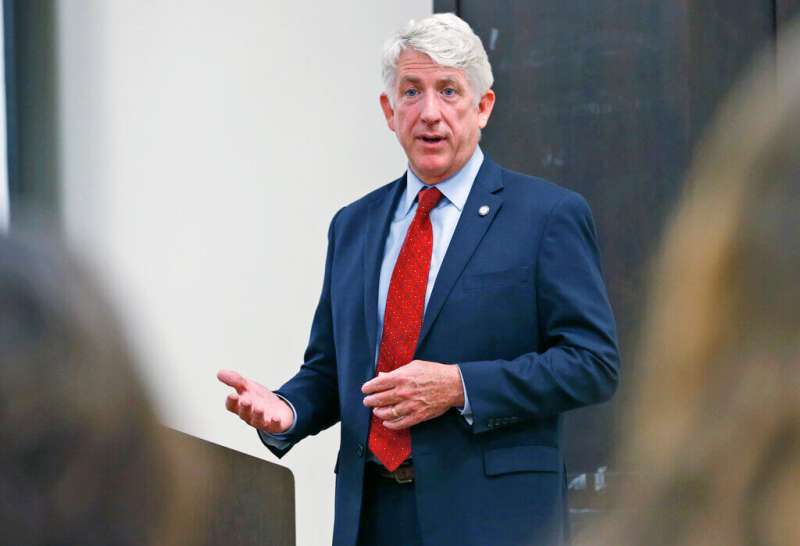
RICHMOND – It’s a settlement nearly four years in the making. In Sept. 2017, Attorney General Mark Herring announced that a bipartisan coalition of state attorneys general sought documents and information from manufacturers and distributors of prescription opioids.
The multi-state investigations into the opioid epidemic led to a half-billion dollar settlement for the commonwealth.
Following Herring’s multi-year investigation, Virginia expects to receive approximately $530 million from three of the top opioid distributors and Johnson & Johnson. The funds will go toward addiction prevention, treatment and recovery.
A Crisis in Virginia
According to Clark Barrineau, the assistant vice president of government affairs at Medical Society of Virginia, there are a multitude of things that led to the opinoid epidemic in Virginia.
“Honestly, there are books written about this subject, so it feels shameful to put it into talking points. But from the medical society’s perspective you see a number of things,” Barrineau said. “Number one – and you’re seeing it now with a lot of lawsuits around prescription opioids in particular – kind of the branding and marketing and efficacy of these drugs that were promoted, and allegedly mis-promoted in some instances, to the medical community and to patients.”
Barrineau said the advertisements often claimed to heal the pain, but swept some of the illicit issues under the rug.
“Number two, unfortunately you also had a growing need for this by patients because that marketing from the pharmaceutical community was so effective,” Barrineau said. “They would break their leg, be in chronic pain and say, ‘I sure would like some oxycontin, please.’”
Due to irresponsible decisions by some physicians, patients who didn’t need an opioid for their injury sometimes attained the drug.
“There’s nothing the Medical Society of Virginia hates more than a bad doctor. They screw it up for all of the good doctors,” Barrineau said. “There’ve been 20/20s about physicians across the country who have misused their responsibility and were running [what were] effectively known as ‘pill mills.’”
Misuse of Opioids
The over-prescribing brought about more than a big payday for some prescription drug companies. It caused an epidemic, which continues despite mitigation strategies.
The National Institute on Drug Abuse describes opioids as generally safe pain relievers, when taken for a short time and as prescribed by a doctor. However, because they produce euphoria in addition to pain relief, some individuals misuse the drugs. If misused, opioid pain relievers can lead to addiction, overdose incidents and death.
Barrineau said that when treating opioid misuse, it’s important to understand the root cause.
“It’s not a matter of ‘just say no.’ It’s a matter of treating the whole person, treating the underlying crisis of that addiction,” Barrineau said. “Are people chasing that euphoria because their home life is negative or downtrodden? Do they have some underlying other issues? Or are they just over-prescribed one day when, I guess, they broke their leg and their brain says, ‘This is the only thing you need in your life right now?’ That’s all it takes to be off to the races.”
A Changing Climate
On a state level, a series of groups embarked on a mission to find ways to control opioid use and reduce over-prescribing.
“Here in Virginia, around the middle part of the last decade, the Board of Medicine, the Department of Health Professions, the MSV, anyone and everyone who cared saw the writing on the wall and put in a lot of different regulations,” Barrineau said.
The regulations ran the gamut from prescribing medications and the length of those prescriptions to continuing education on opioids for doctors prescribing the pain relievers. They also ensured patient tracking through the Prescription Monitoring Program, which allowed doctors access to view opioids prescribed to each patient. The PMP helped medical professionals spot individuals potentially looking for opioids, rather than seeking help for a medical issue.
“We’ve seen people go to work, trying to address all of those [opioid-related issues] in due time. Of course, never quick enough. You know, when you have a problem this large and this bad, saying, ‘We’ve fixed it,’ is almost rude because we haven’t fixed it and we did not fix it quick enough,” Barrineau said. “It’s an ongoing process and that conversation continues to this very day.”
There are also ways everyday Virginians can help solve the crisis.
“I honestly think it comes down to supporting anyone in your life that might be facing these problems. If you are being prescribed opioids, to ask relevant questions. The physician community’s trying hard, but you also have to be cognizant of what you’re getting yourself into and be aware of any and all consequences,” Barrineau said. “But the one thing we need [is] more people to be more sympathetic and be there for one another.”
Amie Knowles reports for The Dogwood. You can reach her at amie@couriernewsroom.com