House subcommittee debates election integrity, voting accessibility.
RICHMOND – Of the 10 bills before the Virginia House Elections Subcommittee Tuesday, members reported only four. The subcommittee considered several bills aimed at promoting election integrity, voting accessibility and transparency. Democrats on the subcommittee, most vocally Del. Paul Krizek (D-Fairfax) and Chairman Schuyler VanValkenburg (D-Henrico), perceived most of the bills as partisan.
Ransone vs. Subcommittee
Del. Margaret Ransone (R-King George) introduced three of the morning’s bills, including HB 2255. The bill, according to Ransone, “seeks to bring transparency … related to communication from the Department of Elections”. The bill required local election officers to post all instructions they received to their city or county’s website within 24 hours.
Ransone defended her bill as nonpartisan and argued she wants to facilitate fair elections. She said election laws were “constantly changing” during the 2020 cycle, which led to widespread confusion among voters.
Krizek countered that because the bill is unclear about potential consequences for failing to post documents online quickly enough, it leaves localities vulnerable to litigation.
“I’m not very sanguine about any election law coming from your side of the aisle right now,” Krizek told Ransone.
After a motion to pass by the bill indefinitely, the subcommittee chairman added, “I think the reason that there’s any confusion in election law is because a lot of political leaders have sown confusion.”
VanValkenburg made it clear who he thought was to blame.
“Our General Assembly session started with three members of your caucus asking Vice President Pence to overthrow Virginia election results, which (President-elect) Biden won by 10 points,” he said.
Republican Dels. Ronnie Campbell of Rockbridge, Mark Cole of Spotsylvania and David LaRock of Loudoun sent a letter to Pence advocating for such action. As a result, all three men lost committee assignments.
Ransone’s Other Bills Rejected
Ransone was also the patron for HB 2267 and HB 2115, both of which failed to advance. The former bill would require any Registrar’s Office or Electoral Board that receives funding besides that allocated by the General Assembly to report it.
Ransone argued it is inequitable if certain localities have better-funded voter education efforts or elections than others. VanValkenburg again questioned the partisan motivation of the bill. He suggested it played into false talking points about elections being unfair or insecure. Why not require such disclosures from all local agencies, VanValkenburg asked? He pointed out that local drug courts sometimes receive grant funding. Schools maintain private booster clubs that help fund stadiums and literacy programs.
Finally, HB 2115 would require mail-in ballots that arrive after Election Day to have a “legible postmark date” on or before the date of the election, Ransone explained.
Several people, including Allison Robbins, president of the Voter Registrars Association of Virginia, spoke in support of the bill. Proponents said it established clear guidance for election officials.
Representatives from both the New Virginia Majority and The League of Women Voters spoke against the bill. Krizek and VanValkenburg again teamed up in opposition.
“I just counted my mail. 50% of the postmarks on it were illegible,” Krizek said. “We don’t want to disenfranchise people just because … it could’ve gotten blurred by water,” he said.
RELATED: What Defines a Virginia Voter?
‘Unreliable and Arbitrary’
Del. C. Todd Gilbert (R-Shenandoah) offered HB 2209, which would require local Electoral Boards to match a signature on file with the signature on an absentee ballot. After contentious deliberations on Ransone’s bills, Gilbert framed his bill as a prime candidate for bipartisan agreement.
“Probably somewhere where we should all be able to agree is that no one should be able to question the integrity of our elections,” Gilbert said. “They should be unassailable.”
Gilbert argued that signature-matching policies were useful in Georgia after the state’s election results were challenged and recertified several times following the Presidential election.
However, those who spoke in opposition to the bill pointed out that election officers have no formal training in handwriting analysis and are not qualified to determine if two signatures match. Furthermore, some voters do not currently have a signature on file with their local Registrar’s Office. The signature on file for most voters comes from their DMV file. DMV signatures are collected via a stylus on a screen, Tram Nguyen of New Virginia Majority said, and can vary significantly from a person’s wet ink signature.
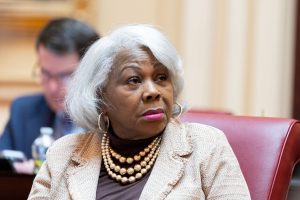
Del. Marcia Price (D-Newport News) also refuted Gilbert’s characterization of events in Georgia. “If we’re going to talk about Georgia … this (policy) was actually bad for a lot of people in the Black, Indigenous and people of color (BIPOC) community,” Price said. She argued that voters from marginalized communities were disproportionately likely to have their vote thrown out because of signature-matching.
Ultimately, Nguyen said, methods such as signature-matching are “arbitrary and unreliable.”
A motion passed to lay the bill on the table.
Increasing Voting Accessibility
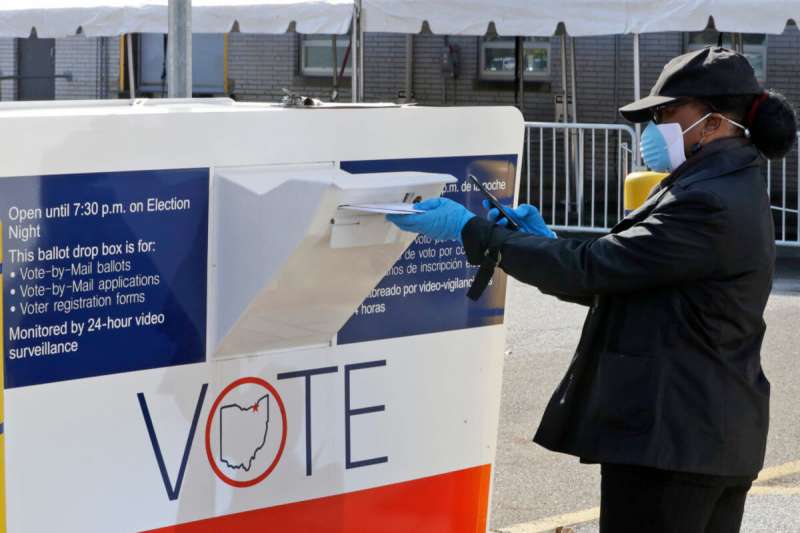
The subcommittee did make progress on Tuesday when it came to increasing accessibility at the polls.
Del. Price’s HB 1921 was one of four bills to pass out of the subcommittee Tuesday. It was the only one that passed unanimously.
Price explained that the bill will make curbside voting “the useful took that…it was meant to be.”
Price described how people who are “disabled, injured or high-risk during an international pandemic” vote curbside out of necessity and physically cannot leave their cars to find an elections officer once they arrive at a polling location.
HB 1921 would mandate that localities “clearly display” instructions for curbside voters about how to notify an officer that they would like to vote. Otherwise, Price said, these voters must bring a support person along to the polls, a precondition that disadvantages and potentially disenfranchises them.
Price said the November 2020 election made clear that curbside voting procedures are “not uniform across this state and we need to raise the minimum standard.”
Colleen Miller, executive director of the Disability Law Center of Virginia, spoke in support of the bill. The center surveyed 400 polling places, she said, and found that 85% had some obstacle to voting. The number one obstacle was to curbside voting.
Ashley Spinks Dugan is a freelancer for Dogwood. You can reach her at info@new.vadogwood.com.