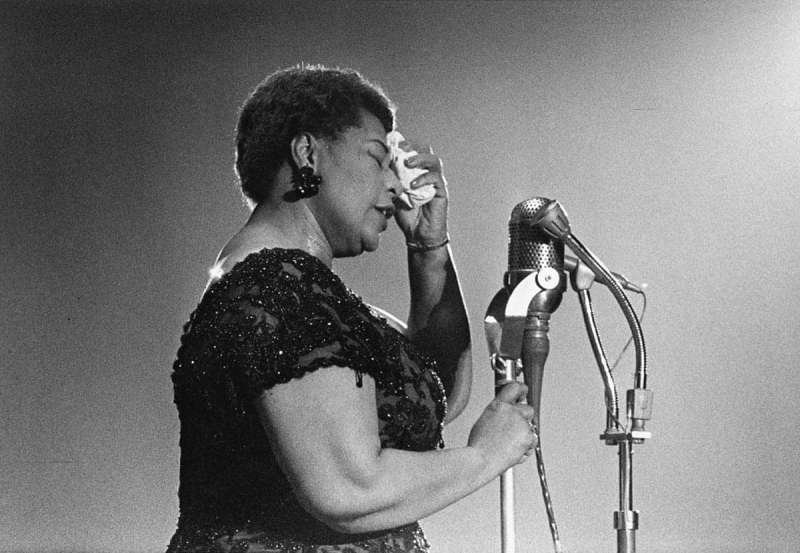
Here are five facts about Ella Fitzgerald, a Newport News native who is one of the greatest jazz singers of all time.
Before she moved to New York and began shaping the singing career that would earn her 13 GRAMMYs and a long-lasting legacy, Ella Fitzgerald was just a girl from Newport News, Virginia. Born in April 1917 to Temperance Henry and William Ashland Fitzgerald, Ella and her parents lived in the East End Section of town until the early 1920s. From there, she moved with her mother to Yonkers, a suburb of New York City, where Ella attended various schools. The pair, along with her mother’s longtime boyfriend Joseph Da Silva and Ella’s half-sister Frances, were members of the Bethany African Methodist Episcopal Church.
When Ella was 15 years old, her mother sustained serious injuries in a car accident and died shortly thereafter. This event altered the course of Ella’s life, as she struggled in the wake of her grief and found herself in enough trouble to be sent to the Colored Orphan Asylum in The Bronx before being moved to a reformatory school for girls due to overcrowding at the orphanage. Many biographers note that it was during this time that Ella began singing on the city streets to earn money.
She had developed a fondness for jazz years earlier thanks to her mother, who brought home one of Connee Boswell’s records. Ella would later say that, “I fell in love with it—I tried so hard to sound just like her.” It wouldn’t be long before she’d get her big break at the famed Apollo Theater, where Boswell’s songs propelled Ella straight into the limelight.
Here are several more fascinating facts about Ella Fitzgerald.
1. Ella Fitzgerald got her big break at the Apollo Theater’s Amateur Night
In 1934, at the age of 17, Ella Fitzgerald made her stage debut during Amateur Night at New York’s famed Apollo Theater. She originally entered as a dancer but made a last-minute decision to sing instead after watching several talented dancers take the stage before her. Ella sang two Connee Boswell renditions, “Judy” and “The Object of My Affection,” and was met with immediate applause from the crowd. She won the competition, which came with a $25 prize, and inadvertently launched her singing career in the process.
Speaking about the experience, Ella said, “Once up there, I felt the acceptance and love from my audience. I knew I wanted to sing before people the rest of my life.” She went on to perform in several other talent shows and competitions in 1935 and eventually met Chick Webb, a famous bandleader and drummer. Chick hired her to travel and play with his band and offered her $12.50 a week for the gig. The rest, as they say, is history.
2. She returned to Virginia at the beginning of her singing career
Ella Fitzgerald quickly became a household name in the 1930s once she began touring and recording her own music. Though she only spent about two years in Virginia before moving to New York, the “First Lady of Song” returned to the area to perform at Jackson Ward’s Hippodrome Theatre and the Cavalier Hotel’s Beach Club. Notable big-band performers like Cab Calloway, Benny Goodman, and Frank Sinatra also played at the Beach Club between the 1930s and 1950s.
Virginia Is For Lovers notes that during the beginning of her career, Ella was unable to perform at many of the venues around Richmond due to racial segregation. This would unfortunately become a recurring theme, though she did receive help from one of Hollywood’s most famous movie stars when faced with adversity years later.
3. Marilyn Monroe helped her receive fair treatment from nightclub owners
During a time in her career when she struggled to book certain shows, Ella Fitzgerald found an unexpected friend and ally in Marilyn Monroe. In a 1972 interview, Ella recounted how the “Gentlemen Prefer Blondes” star helped her book a lucrative nightclub gig after the owner reportedly claimed that Ella wasn’t “glamorous” enough to sing to his patrons.
Speaking with Ms. Magazine, Ella explained, “I owe Marilyn Monroe a real debt. It was because of her that I played the Mocambo, a very popular nightclub in the ‘50s. She personally called the owner of the Mocambo and told him she wanted me booked immediately, and if he would do it, she would take a front table every night. She told him—and it was true, due to Marilyn’s superstar status—that the press would go wild. The owner said yes, and Marilyn was there, front table, every night. The press went overboard—After that, I never had to play a small jazz club again. She was an unusual woman—a little ahead of her times. And she didn’t know it.”
This wasn’t the only time that Marilyn stepped in on Ella’s behalf. There was an incident in Colorado where Ella was being forced, due to racial discrimination, to use either the back or side entrance to enter a venue she was playing. Marilyn had traveled to see Ella perform and witnessed the legendary singer being redirected away from the front upon her arrival. When this happened, Marilyn told the venue’s owner that she wouldn’t go inside to attend the performance unless Ella was allowed to enter through the front doors as well. The owner agreed, and the incident reportedly set the tone for all of Ella’s future performances across the US, as other venue owners and managers then ensured she was treated fairly.
4. She was the first African-American woman to win a GRAMMY
In 1958, Ella Fitzgerald became the first African-American female to win a GRAMMY at the very first GRAMMY Awards. Two of her albums, including “Ella Fitzgerald Sings The Irving Berlin Songbook” and “Ella Fitzgerald Sings The Duke Ellington Songbook,” were nominated that year. She was up for the “Best Vocal Performance, Female” award and the “Best Jazz Performance, Individual” award, and won for both. Throughout the span of her career, Ella won 13 GRAMMYs and also became the first woman ever to win multiple awards from the prestigious Recording Academy.
5. She established the Ella Fitzgerald Charitable Foundation to assist those in need
The Newport News native went on to create the Ella Fitzgerald Charitable Foundation in 1993 to provide numerous services to people in need, including fostering a love of music and reading and supporting the establishment of a more fruitful life. The foundation does this by creating educational opportunities for music students and children from disadvantaged communities, providing shelter, food, health care, and counseling, and focusing on medical research into heart disease, vision issues, and diabetes.