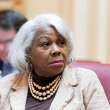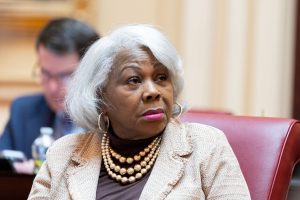
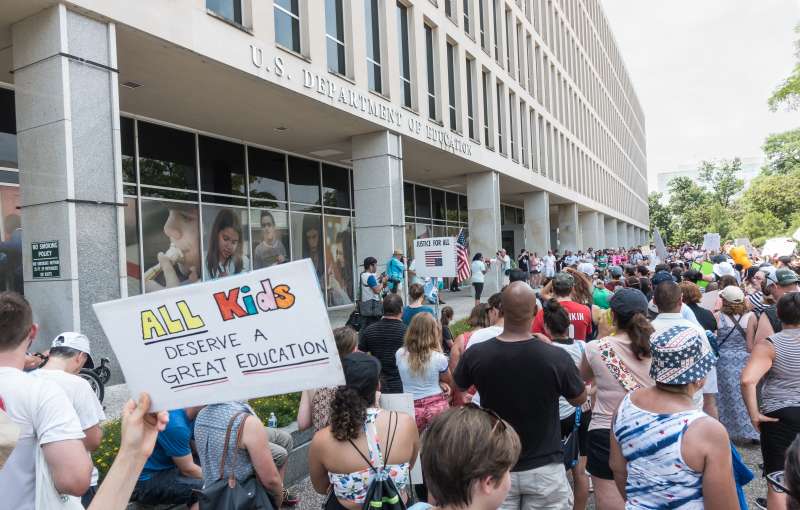
Denise Harrington, an educator and member of the League of Women Voters, grew up as America was desegregating its schools. As a young student, though, her only option was Hampton University’s Laboratory School in Virginia, which she attended through a scholarship/voucher program.
“That’s how I was educated from kindergarten to second grade, and then things did not open up until I was in third grade, which would have been 1970,” Harrington said. “That’s the only time it was safe for me to go to a public school.”
Harrington said the shift was stark.
Public school teachers were better equipped to work with students with special needs, and students were better prepared for college. As an adult, acquaintances are sometimes surprised to learn she attended a private school as a child, but when she explains it was a result of segregation and that her education suffered as a result, their tune changes.
Harrington went on to teach for 36 years and noticed a gap between students receiving private and public education, which she attributed to private school curricula not being dictated by the state.
“I’ve seen children come from these schools; they have less knowledge of everything, and we have to catch them up in the public schools,” she said.
Harrington’s experiences have informed her critical eye toward modern voucher programs in Virginia and beyond.
Where vouchers stand today in Virginia—and what’s at stake
Virginia has taken a more scaled-back approach to school vouchers than some other states. But the state’s school voucher landscape could change next year with the rollout of a new federal voucher program implemented by the Trump administration.
Critics say the federal program could divert more funds from public schools, affecting the quality of education for students who remain in them. Supporters say the changes will expand choice for families and help students afford programs that better fit their needs.
Virginia’s current state system is called the Education Improvement Scholarships Tax Credits Program. The program gives donors state tax credits for qualifying contributions to Scholarship Granting Organizations (SGOs), which provide scholarships to eligible students attending participating private schools.
Patrick Cremin, a staff attorney with the Education Law Center, called Virginia’s program “interesting” and said it is much smaller than those in most states, with its $25 million annual cap and income limit.
“Virginia is pretty unique. It’s kind of like an old-school program in the sense that it has retained both the income limit and spending cap limit,” said Cremin.
Currently, the state has about 105,000 students enrolled across its 650 private schools. Not all of those students use scholarships through Virginia’s state program, but students who are already enrolled in qualifying private schools could receive additional scholarship funds after the federal rollout.
The federal program, commonly known as the Education Freedom Tax Credit, was established as part of the 2025 One Big Beautiful Bill Act (OBBBA) and will take effect in 2027. It offers federal tax credits of up to $1,700 to taxpayers who make qualifying contributions to SGOs.
States must elect to participate and identify qualifying SGOs to the IRS by Jan. 1, 2027. Virginia has already made an advance election to participate for 2027.
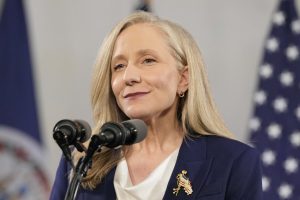
When former Gov. Glenn Youngkin announced that Virginia would opt in to the federal program, the president of the Virginia Education Association called it “an outrageous, last-minute political stunt.” Now, Gov. Abigail Spanberger is under pressure to withdraw from the program before it takes effect.
What will Spanberger do?
If Virginia stays in, critics like the National Education Association and VEA President Carol Bauer estimate that losses to the state’s public schools could reach between $222 million and $956 million annually. This figure assumes that the federal program could lead to enrollment declines similar to those associated with voucher programs in other states. The estimate applies those enrollment shifts to Virginia’s public school population and average per-pupil spending.
Harrington is critical of the federal program.
“Voucher schools are not accountable to an elected school board or board of supervisors, so it’s public money going for private use,” she said.
Supporters argue that parents can hold participating schools accountable by choosing where their children enroll, and that further regulation could limit the autonomy under which private schools operate. Meanwhile, critics say educational voucher programs lack transparency and, therefore, accountability, leaving private schools with more discretion in admissions.
Harrington argued that this freedom could lead to discrimination.
“They can just kick you out. Period,” Harrington said.
So far, 30 states have opted in to the federal program. A handful have formally opted out, but the rest have yet to announce their decisions either way. Virginia is one of only three states—alongside Colorado and New York—with a Democratic trifecta that has opted in. Twenty-three states have a Republican trifecta, underscoring the partisan divide over school choice.
“It would be a big deal if they did opt (to stay) in because it would basically introduce a potentially much larger voucher program in a state that only has a small one,” Cremin said.
Harrington said she understands Virginia parents’ inclination to find a suitable educational fit for their child, but worries more vouchers will only add to further division.
“When parents say we want choices, you say, ‘Great. We want you to have choices,’” Harrington said. But she emphasized that charter schools, which operate under the umbrella of the public school system, offer “choice” without vouchers that subsidize private education.
Spanberger has yet to back out of the federal program. But her education platform states she will “reject efforts to divert funding from public education to pay for voucher programs.”