
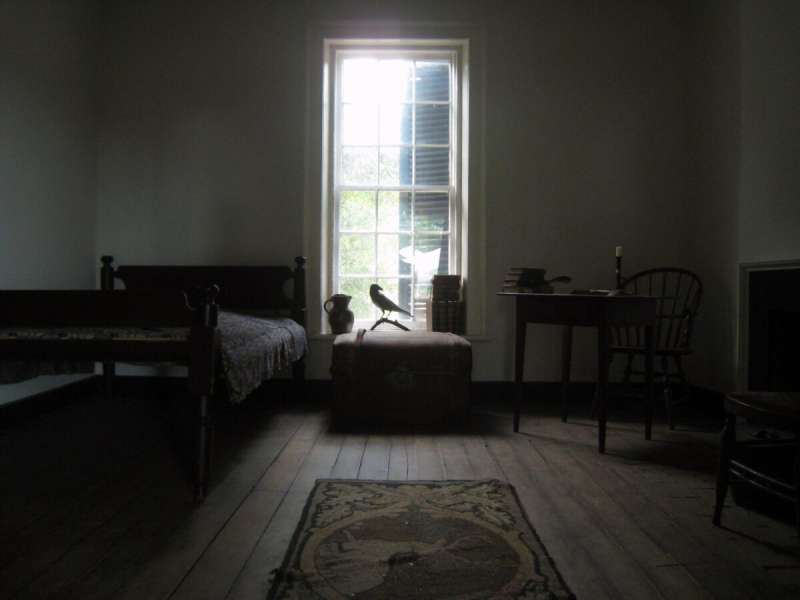
Most textbooks recap specific, traditional details. Here are six creepy facts about Virginia you might not know.
I’ve always been drawn to the darker, more macabre aspects of life, because much like Lydia Deetz, “I, myself, am strange and unusual.” This fascination began when I stumbled across a collection of Edgar Allan Poe’s work in my elementary school library. Though I was too young to understand much of what he was saying, I found the odd imagery in his work appealing. Ravens and masks, seaside graves, and black cats—I couldn’t get enough of Poe’s writing, and the way it made me feel to picture these details in my own imagination.
It’s fitting that I now get to talk to you about the time Poe etched one of his poems onto his bedroom window at the UVA, among other creepy facts about Virginia you may not know. It’s important to note that I’m using the term “facts” here since some of these things do exist, whereas others are things that people believe exist. I’m not saying the hauntings, vampires, or urban legends themselves are facts, just that some (including myself) believe they are, and the belief is factual, even if the cryptids aren’t.
1. Edgar Allan Poe etched one of his poems onto a UVA window
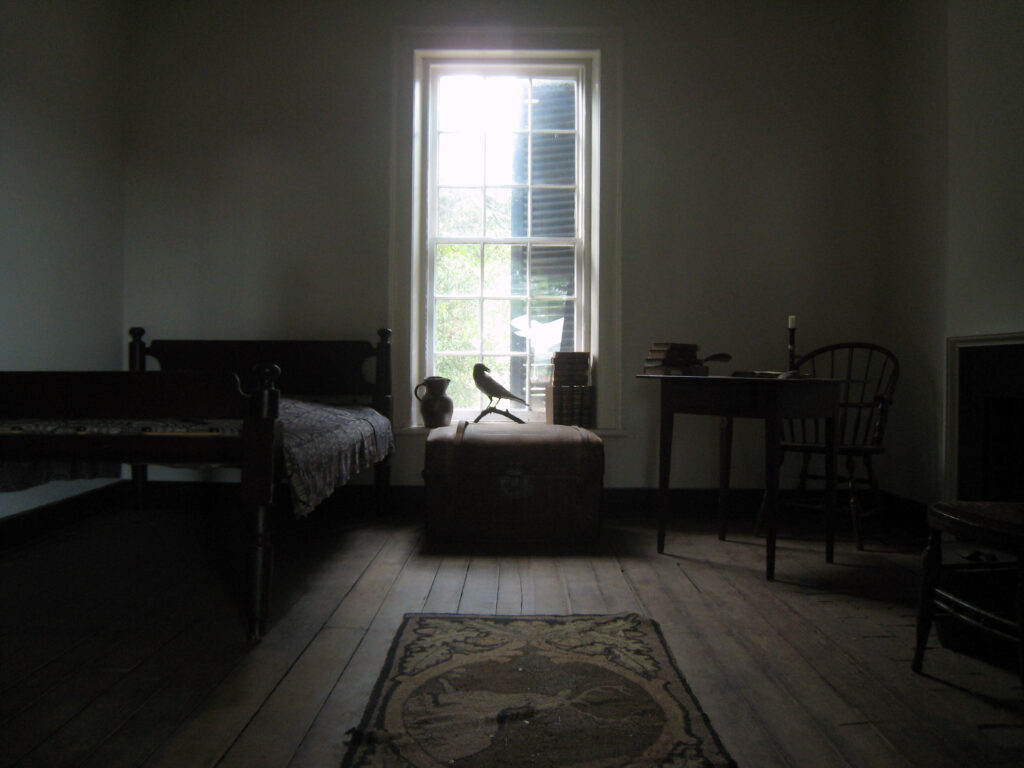
From February to December 1826, Edgar Allan Poe was a student at the University of Virginia, where he reportedly lived in Room 13 on the West Range. Several areas of the university are rumored to be haunted, and one of the spooky details supporting this belief is a poem that Poe etched onto his window before leaving UVA. The poem reads: “O Thou timid one, let not thy/Form rest in slumber within these/Unhallowed walls,/For herein lies/The ghost of an awful crime.”
No one can say for certain which ghost Poe may have been referring to, though UVA Magazine notes that there’s allegedly an entity dressed in Victorian clothes that has been spotted numerous times in Pavilion X. Dr. Bennett Wood Green’s ghost has also reportedly haunted the school after his books were donated to the university library following his death.
While we can’t know for sure if Poe himself saw anything supernatural during his time at UVA, we can at least enjoy the poem he left behind, as it’s viewable at the school’s Shirley Small Special Collections Library. Click here to see the window.
And, according to Visit Charlottesville, you can view Poe’s old room as well, which has been “restored to the 1826 time period, when he was a student at the University of Virginia. A glass door allows visitors to see the room furnished as a student room would have been in the early 19th century. A button can be pressed to hear a recording about Poe’s time at U.Va.”
2. Crawford Road is reportedly haunted
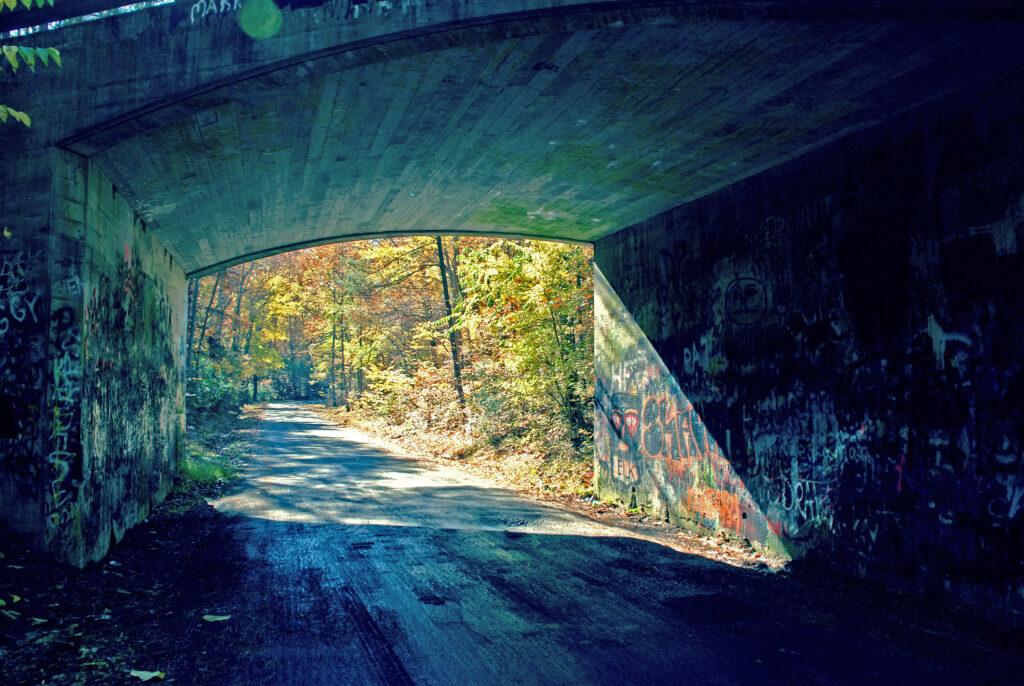
Yorktown’s Crawford Road has a reputation for being one of the most haunted places in Virginia. Numerous theories exist as to who’s haunting the area, with some explanations feeling more plausible than others. A few of these tales are rooted in real-life tragedies, like KKK lynchings and the relatively frequent discovery of human remains on Crawford Road and in the surrounding woods. Regardless of whether you believe in the supernatural, this 3.6-mile stretch of road running through the Virginia Historic Triangle has seen its fair share of violence over the years.
The body of James “Jimmy” Johnson was discovered in the woods in 1990, and the body of a woman who police believe was Tonya Lane was found shortly thereafter. Langley Airman Eric Nesbitt was found dead off Crawford Road in 1996, and Shawn Demonta Mabry’s body was discovered in the surrounding woods in 2000. WYDaily dove into the details of those cases back in 2018, which you can read more about here.
In terms of why Crawford Road is believed to be haunted, that explanation is pretty straightforward. Some people have claimed they’ve heard shrieking or seen ghostly figures while driving under the Crawford Road Bridge. Being in such close proximity to so many murders can oftentimes make people feel on edge, which can lead to an abundance of perceived paranormal activity.
3. Fairfax County is home to an unsettling urban legend: The Bunny Man
When I first heard the name “The Bunny Man,” I immediately thought of the scene from “Donnie Darko” where Jake Gyllenhaal’s character, Donnie, asks Frank (who is a figment of Donnie’s imagination, dressed in a rabbit suit), “Why are you wearing that stupid bunny suit?” Is that a question I would actually ask the alleged Bunny Man of Fairfax County? No. Especially not after reading about how the urban legend came to be.
People who are from Northern Virginia might already be familiar with this story, but I’ll tell it to you anyway. According to the Washington Post, the legend goes that, “Every Halloween, the ghost of a murderous escapee from an insane asylum appears at the bridge, which goes over Colchester Road near Clifton.” Though certain elements have obviously been dramatized (i.e., a murderous escapee from an insane asylum), other aspects of the story are actually true.
In the 1970s, two real incidents occurred involving an axe-wielding man who was allegedly wearing a bunny suit. The first was reported on October 19, 1970, in Burke. Robert Bennett, who as a U.S. Air Force Academy Cadet, and his fiancée were returning to a home on Guinea Road—where they were staying with relatives—around midnight. They said they noticed movement outside the rear window of their vehicle, and then mere moments later, a man in a white suit smashed the passenger side window. Bennett immediately drove off, only to discover a hatchet on the floor of the car after they left the area. Bennett claimed that the suit was actually a bunny costume, but his fiancée said she believed the man had been wearing a white hood.
Then, on October 29, 1970, Paul Phillips, who was a construction security guard, said he confronted a young man on Guinea Road wearing a white, black, and gray bunny costume who was holding an axe. The man told Phillips that he was trespassing, and that he would attack Phillips if he came back.
Police investigated both incidents but ultimately had to close the cases without any real conclusions due to a lack of evidence. Over time, the idea of a potentially murderous man in a bunny suit evolved and transformed into the Bunny Man legend most commonly told today.
4. Several sanatoriums were run in the state
Several sanitoriums were run in Virginia, with two of the most notable being DeJarnette and St. Albans. As Virginia.org notes, “Sanatoriums were notoriously cruel in the early 20th century, using methods like electroshock therapy, lobotomies, and other archaic practices on the patients.” St. Albans was known for reportedly using these experimental methods that were more akin to torture, resulting in the deaths of countless patients.
The sanatorium’s website states that, “the doctors and nurses at St Albans dedicated their skills to healing the minds of those souls often discarded by society or left to wander in the dark,” which may be true in certain cases … but not all. Due to this history of alleged cruelty, it’s believed that St. Albans is haunted. The sanatorium has decided to lean into that, opting to host flashlight tours, masquerade balls, and other similar events.
The DeJarnette Sanitarium had also built a reputation for its cruel and unusual practices, including the sterilization of patients. You can read more about the complicated, unsettling history of how that happened and why here. It ceased being a sanatorium in the mid-1970s and operated as a children’s hospital for two decades before closing permanently in 1996. Like St. Albans, people believe DeJarnette is haunted, and some even like to visit the abandoned building in an attempt to see ghosts.
5. Manassas’s Stone House has a history of ghostly sightings
I’m sure you’re noticing a trend here: A lot of the creepy facts about Virginia center around ghosts. Given the extensive, bloody history of the state, this makes sense to me. Then again, I did already tell you that I’m a believer in all things supernatural, so I understand if you’re less convinced.
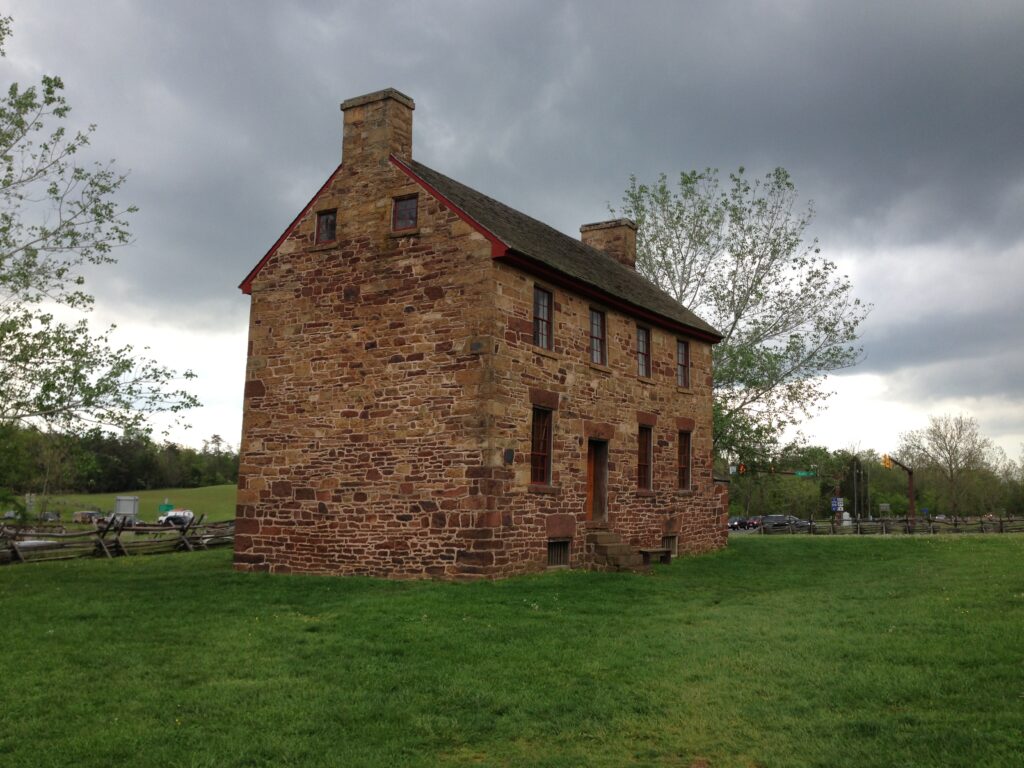
That being said, the Stone House in Manassas operated as a field hospital during the Civil War, and many, many men died on the property during that time. Visitors have reportedly seen several ghosts, including that of Eugene Geer, who died in an upstairs bedroom of the hospital. Other dead soldiers have been spotted over the years from both the Confederate and Union sides of the battle, since men were taken there for treatment regardless of their affiliation. Ghosts tend to manifest when they have unfinished business, so the lost souls of hundreds of men who died in the middle of fighting a war sounds plausible … if you believe in that sort of thing …
Click here if you want to learn more about the historical war aspects of the Stone House.
6. There were rumors of a vampire living in Richmond
Last, but certainly not least, I bring you frightening rumors out of Richmond. In the 1920s, residents claimed that there was “a vampire lurking in the shadows of Hollywood Cemetery,” who was “dripping blood and flesh” and slept inside a tomb on the cemetery grounds (sounds like a dream to me).
The Commonwealth Times originally ran a story about these alleged vampire sightings, claiming that the creature was primarily seen near the grave of William Wortham Pool. Pool died in 1922 from pneumonia. His name, W.W. Pool, is engraved above his crypt, and the W.W. etched in stone seemingly resembles a pair of vampire fangs. This is apparently why people thought back then that he was a blood-drinking undead being instead of a dead elderly man who happened to be interred in a mausoleum.
Want to learn more about this mysterious tale? Click here.
This article first appeared on Good Info News Wire and is republished here under a Creative Commons license.
Related: The Hillsville Massacre: How a stolen kiss led to 5 deaths & a century of unanswered questions